
'%3e%3cpath%20fill-rule='evenodd'%20clip-rule='evenodd'%20d='M6%200C10.4183%200%2014%203.58171%2014%207.99999V14.0003C14%2018.4186%2017.5817%2022.0003%2022%2022.0003H122C126.418%2022.0003%20130%2018.4186%20130%2014.0003V8C130%203.58172%20133.582%200%20138%200H6Z'%20fill='%23EDF2E7'/%3e%3c/g%3e%3cdefs%3e%3cfilter%20id='filter0_d_12223_4749'%20x='0'%20y='0'%20width='144'%20height='36'%20filterUnits='userSpaceOnUse'%20color-interpolation-filters='sRGB'%3e%3cfeFlood%20flood-opacity='0'%20result='BackgroundImageFix'/%3e%3cfeColorMatrix%20in='SourceAlpha'%20type='matrix'%20values='0%200%200%200%200%200%200%200%200%200%200%200%200%200%200%200%200%200%20127%200'%20result='hardAlpha'/%3e%3cfeOffset%20dy='8'/%3e%3cfeGaussianBlur%20stdDeviation='3'/%3e%3cfeComposite%20in2='hardAlpha'%20operator='out'/%3e%3cfeColorMatrix%20type='matrix'%20values='0%200%200%200%200.356863%200%200%200%200%200.427451%200%200%200%200%200.270588%200%200%200%200.7%200'/%3e%3cfeBlend%20mode='normal'%20in2='BackgroundImageFix'%20result='effect1_dropShadow_12223_4749'/%3e%3cfeBlend%20mode='normal'%20in='SourceGraphic'%20in2='effect1_dropShadow_12223_4749'%20result='shape'/%3e%3c/filter%3e%3c/defs%3e%3c/svg%3e)
Foot Foundation First
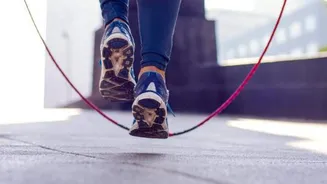
The overhead press, like any strong lift, begins from the ground up. Your feet provide the essential stable base. Aim for a stance roughly as wide as your
hips, with toes pointing forward or slightly outward, whichever feels most natural and secure. It's vital to distribute your body's weight evenly across your foot, feeling pressure through your heel, the ball of your foot (specifically near your big toe), and the outside edge (near your pinky toe). This 'tripod' stance prevents you from rocking too far forward onto your toes or leaning excessively back onto your heels, creating a grounded and unwavering foundation for the entire movement. Imagine actively gripping the floor with your feet to maximize stability and engagement.
Rooting and Lower-Body Engagement
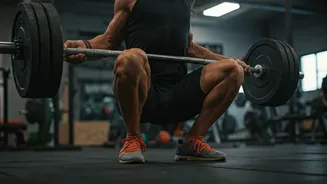
Building on that solid foot foundation, the next step involves generating tension throughout your entire lower body. This full-body engagement is critical for a stable torso and a controlled bar path. Begin by actively gripping the floor with your toes, then imagine 'screwing' your feet into the ground by creating a slight outward rotation at your hips. Simultaneously, engage your glutes firmly; this action is key to preventing your lower back from arching excessively during the press. Maintain a slight tension in your quadriceps without locking your knees completely. This controlled tension from your feet all the way up to your hips ensures your torso remains locked in place, significantly contributing to shoulder health and an efficient lift.
Precision Grip and Wrist Alignment
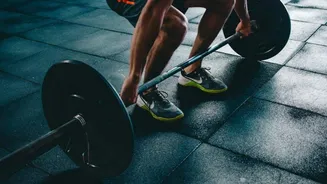
Your grip on the barbell dictates the control you have over the entire pressing motion, influencing bar path, shoulder mechanics, and force transfer. A grip set just outside shoulder width is generally optimal. Crucially, strive to maintain neutral wrists, avoiding excessive bending forward or backward. Position the barbell in the heel of your palm rather than letting it rest heavily on your fingers, which can lead to instability and a loss of power. The goal is to align your forearms vertically directly under the bar, creating a straight line that allows for the most efficient and powerful upward press. Think of your knuckles pointing towards the ceiling as a cue.
Optimal Rack Position
The rack position is where the barbell rests before you initiate the press, and a correct setup here is paramount for an effective lift. Ideally, the bar should be supported on your upper chest or collarbone, with your wrists slightly bent to accommodate this if necessary for mobility. It’s important to keep your elbows positioned slightly in front of the bar, not directly underneath it or flared far out to the sides. Actively engage your lat muscles to help stabilize the bar and your upper body. Simultaneously, ensure your ribs are pulled down and stacked directly over your hips, maintaining an upright torso.
Breathing and Core Bracing
A robust overhead press requires significant full-body tension, and a proper breath and brace technique are foundational. Without it, your lower back can excessively arch, your ribs might flare, and the bar could drift forward. To achieve this, take a deep, 360-degree breath, filling your abdomen, sides, and lower back with air. Consciously pull your ribs down, stacking them directly over your hips. Then, brace your core as if you're anticipating a blow. This action locks your torso, providing a solid platform from which to press. Aim to maintain this braced position throughout the initial part of the press.
Upper-Body Tension and Bar Path
Before you even begin the upward press, your upper body needs to be fully engaged and locked in. Muscles like your lats, traps, and the muscles of your upper back play a vital role in guiding the bar along its intended path and keeping your torso steady. Reconfirm your glute engagement and ensure your lats are actively working to help guide the bar and stabilize the bottom position. Maintain a proud chest while keeping your ribs down, and tuck your chin slightly so the bar can clear your face as you press upwards. Think of creating a stable 'shelf' with your upper back by pulling your shoulder blades back, and avoid feeling relaxed in this setup phase.
Final Green Light Check
Before you initiate the press, perform a quick mental checklist to confirm all your setup elements are in place. This 'green light' pause ensures you're ready for an optimal rep. Verify that your feet are firmly planted, your quads and glutes are lightly squeezed, and your core is braced with your ribs over your hips. Confirm your elbows are forward, your wrists are stacked over your elbows, and the bar is correctly positioned on your upper chest. Ensure your chin is tucked and your eyes are looking forward. Once this rapid scan is complete, you are primed to execute a powerful overhead press.