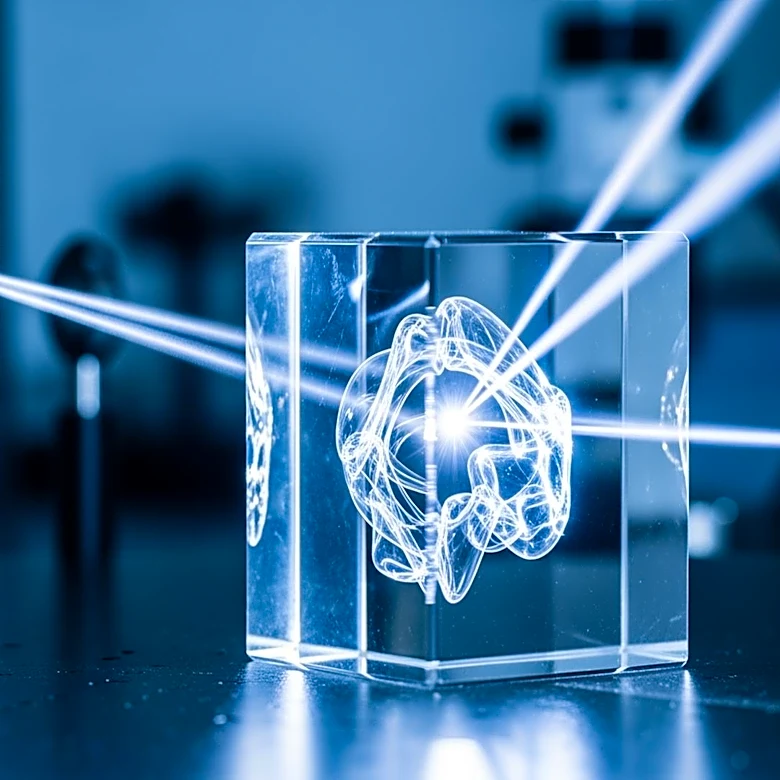
XPANCEO Researchers Use Light to Sculpt Einstein on Crystal, Advancing Photonics
Researchers from the XPANCEO Emerging Technologies Research Center, in collaboration with Nobel Laureate Prof. Konstantin Novoselov, have discovered a novel optical behavior in arsenic trisulfide (As2S3), a crystalline van der Waals semiconductor. This material can be permanently altered by light, allowing it to be shaped at the nanoscale using continuous-wave light. This discovery eliminates the need for costly cleanroom fabrication or advanced laser systems. The material's refractive index, which describes how much it bends or slows light, can be significantly altered by light exposure, a phenomenon known as photorefractivity. This capability is crucial for creating optical functions directly within the material, supporting technologies in telecommunications, sensors, and security. The researchers demonstrated this by using a laser to create a microscopic portrait of Albert Einstein on the material, achieving high precision and resolution.