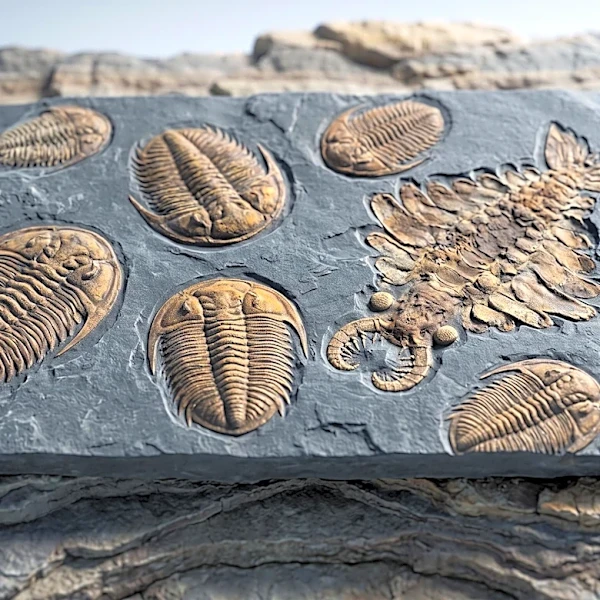
Cambrian Explosion Reveals Rapid Diversification of Early Animal Life
The Cambrian period, beginning approximately 540 million years ago, is marked by a phenomenon known as the Cambrian explosion, which saw the geologically sudden appearance and rapid diversification of many major animal lineages in the fossil record. This period is characterized by a swift expansion of skeletonized forms and increased ecological complexity, including the emergence of arthropods, molluscs, and early chordates, complete with eyes, limbs, guts, and armor. Key fossil discoveries, particularly from the Burgess Shale in British Columbia, provide exquisite detail of soft-bodied organisms from around 508 million years ago. Notable examples include Anomalocaris, a large predator, and trilobites, which are iconic arthropods that diversified into thousands of species and are used as index fossils for correlating Paleozoic strata.