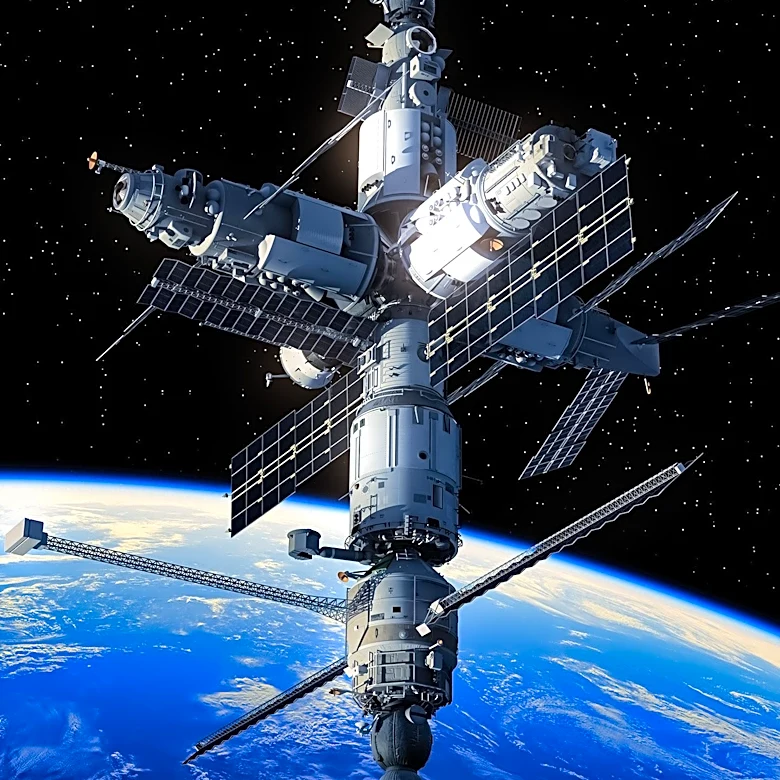
Early Concepts of Space Stations, Including Rotating Wheels for Artificial Gravity, Explored in Historical Review
A historical review delves into the early conceptualization of space stations, tracing ideas from 19th-century fiction to early 20th-century scientific proposals. The earliest known fictional space station, 'The Brick Moon,' was published by Edward Everett Hale in 1869, envisioning a 200-foot-diameter sphere in orbit as a navigation aid, accidentally launched with people aboard. As the 20th century began, figures like Konstantin Tsiolkovsky and Hermann Oberth provided theoretical foundations for rocket flight and space habitation, including the concept of rotating habitats to generate artificial gravity. Hermann Potočnik (writing as Hermann Noordung) further detailed this in 1929 with his 'Wohnrad' (habitation wheel) design, which significantly influenced later concepts, notably Wernher von Braun's wheel-shaped stations popularized in the 1950s through publications like Collier's and Walt Disney television specials.