Astronomers Precisely Measure Binary Red Dwarf System DG CVn Using NSF VLBA
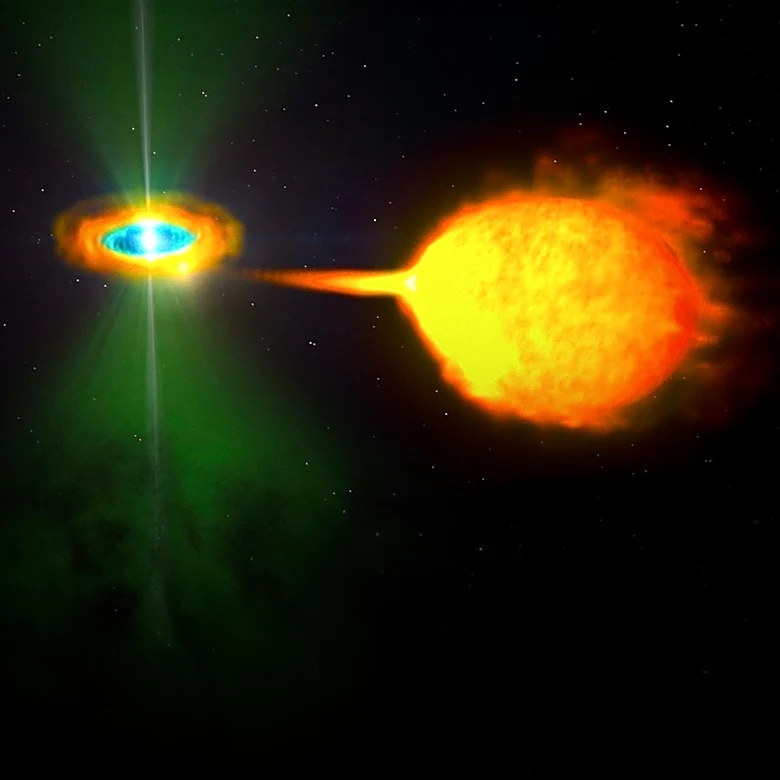
Astronomers have achieved unprecedented precision in measuring the orbit, masses, and distance of DG CVn, a binary system composed of two active red dwarf stars located approximately 59 light-years from Earth. Utilizing the U.S. National Science Foundation's Very Long Baseline Array (NSF VLBA), a team led by Paul Boven discovered that both stars in DG CVn emit detectable radio waves, enabling individual motion tracking. By combining 18 years of observations, including new NSF VLBA data from 2023 to 2025, researchers accurately determined the stars' orbital parameters and masses. The study, published in Astronomy & Astrophysics, reveals that the two stars orbit each other every 4.511 years in an elliptical path, with the more massive star (DG CVn A) having about 39% of the Sun's mass and DG CVn B having about 36%. This detailed analysis provides one of the most precise dynamical measurements for such a binary system to date.