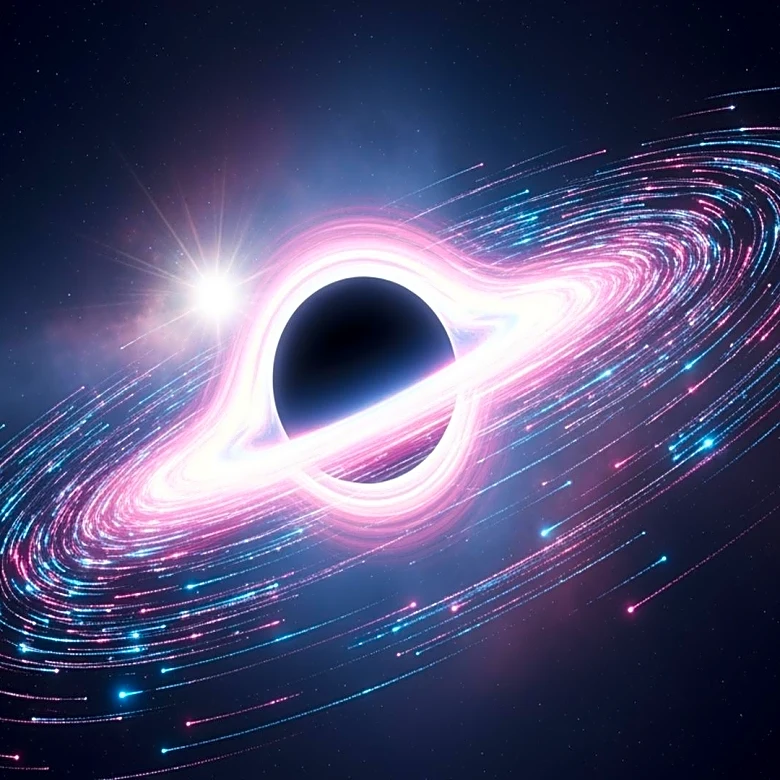
UMass Amherst Physicists Propose Black Hole Explosion Theory to Explain High-Energy Neutrino
Physicists at the University of Massachusetts Amherst have proposed a theory that a special kind of black hole, known as a 'quasi-extremal primordial black hole,' could explain the detection of a high-energy neutrino that crashed into Earth in 2023. This neutrino carried energy levels 100,000 times greater than those produced by the Large Hadron Collider, the world's most powerful particle accelerator. The team suggests that these black holes, formed under primordial conditions shortly after the Big Bang, could emit particles through a process known as Hawking radiation. As these black holes evaporate, they become lighter and hotter, eventually leading to an explosion that could be detected by current cosmic observation instruments. This theory could potentially provide a comprehensive catalog of subatomic particles, including those hypothesized but not yet observed.