JWST Identifies Black Hole Disguised as Enormous Star in Early Universe
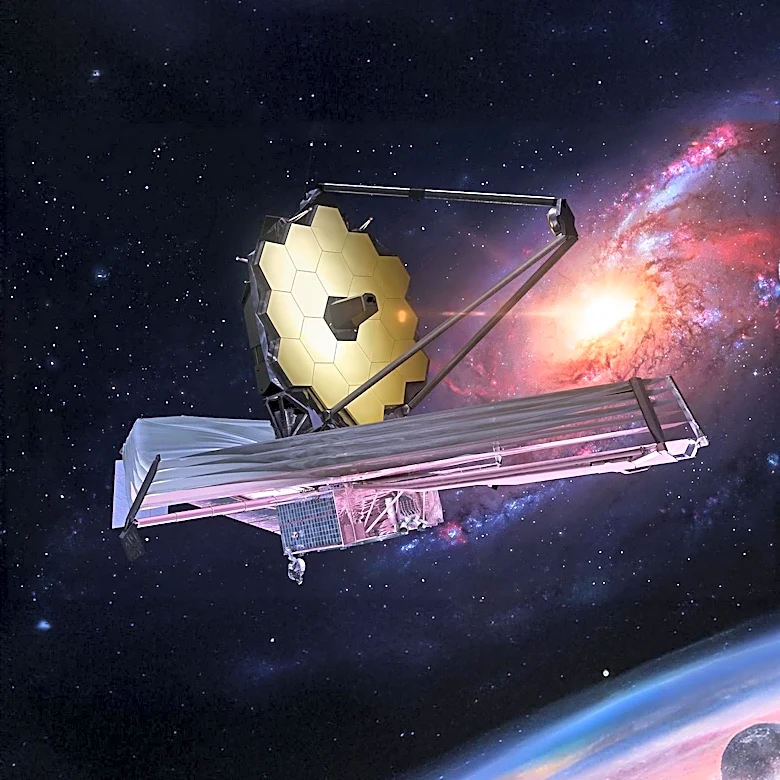
The James Webb Space Telescope (JWST) has identified a compact red source, MoM-BH*-1, in the early universe, approximately 660 million years after the Big Bang. Initially, its spectrum made it appear similar to an enormous star. However, astronomers, led by Rohan Naidu, determined that its total light output is roughly 100 billion times the Sun’s luminosity, a level unsustainable by any ordinary star. The preferred explanation is a feeding black hole surrounded by an extraordinarily dense envelope of hydrogen. The JWST's NIRSpec instrument observed a significant drop in measured flux between three and four micrometers, a feature known as the Balmer break. While stellar populations produce this break, MoM-BH*-1's break strength of 7.7 far exceeds the typical peak of 3 for a dust-free stellar population, or even 5 for an extreme population of A-type stars. This, combined with broad hydrogen emission and deep hydrogen absorption, led to the conclusion that a normal collection of stars could not explain the ob...