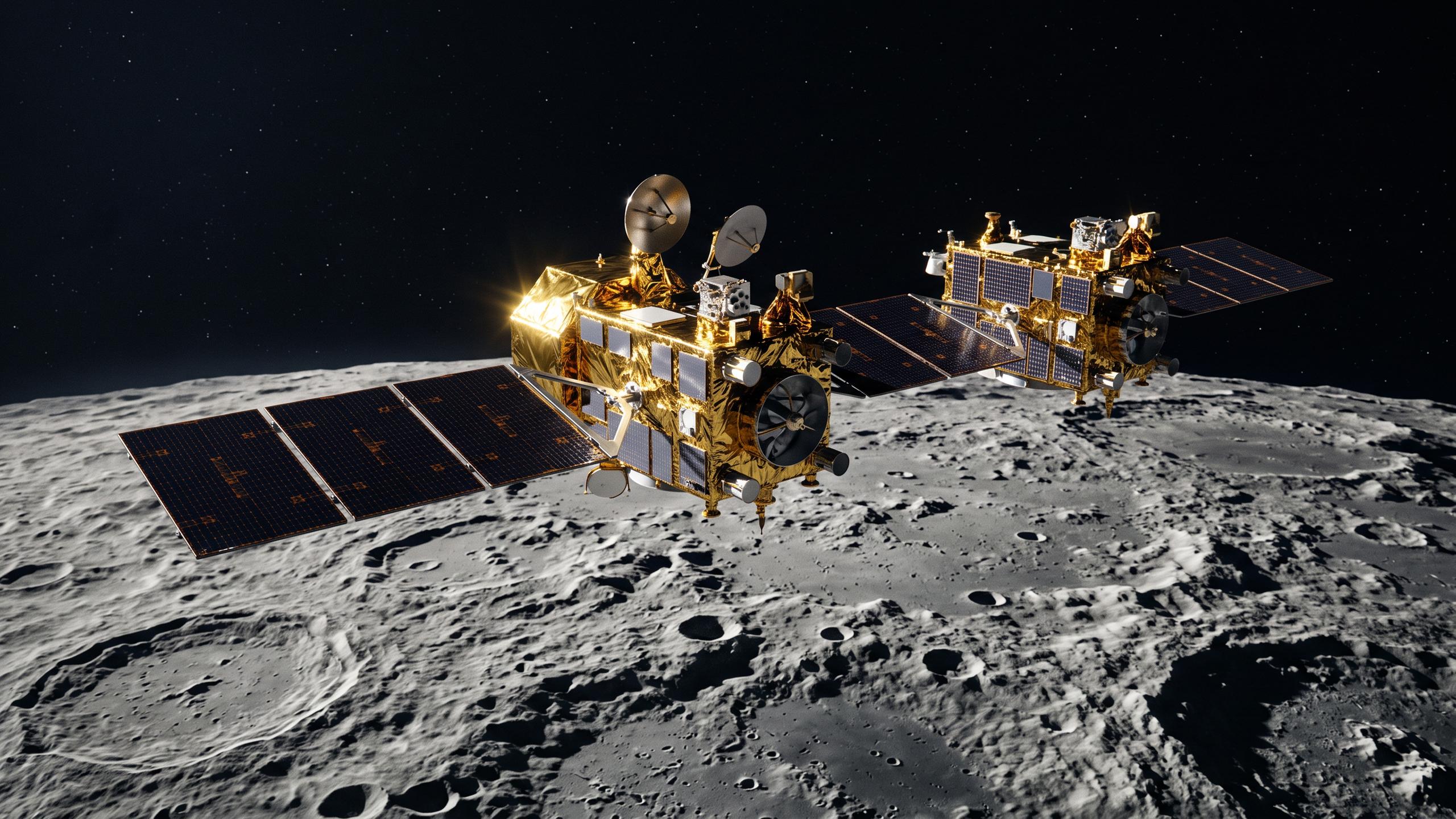
NASA's GRAIL Mission Successfully Mapped Lunar Interior Before Planned Impact
The Gravity Recovery And Interior Laboratory (GRAIL) mission, a dual spacecraft effort by NASA, successfully completed its primary objective of mapping the structure of the lunar interior. Launched on September 10, 2011, GRAIL-A and GRAIL-B embarked on a 3.5-month low-energy trans-lunar cruise before entering lunar orbit in late December 2011 and early January 2012, respectively. The spacecraft then settled into tandem 50 km, 113-minute near-circular lunar polar orbits, separated by 175-225 km. Over a 90-day science phase, divided into three 27.3-day cycles, the GRAIL mission used a Ka-band payload, the Lunar Gravity Ranging System (LGRS), to make high-precision range-rate measurements between the two spacecraft. This data was crucial for determining the Moon's gravitational field and, consequently, its internal structure. The mission concluded with a planned decommissioning phase and lunar surface impacts on December 17, 2012.