






What is the story about?
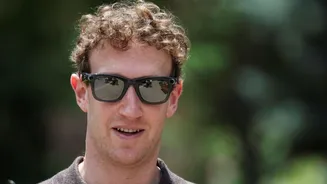
The US should not block Chinese AI models, Meta CEO Mark Zuckerberg has said, arguing that doing so won’t help America stay ahead in the global artificial intelligence race.
Zuckerberg said banning advanced Chinese AI models in the US would not be an effective solution and suggested that the US should focus on building better AI technology rather than restricting access to foreign models, he said in an interview with the Financial Times.
His comments come as the US government considers tougher action against some ChineseAI companies over allegations of intellectual property theft and concerns about national security.
Earlier this month, Beijing-based AI company Moonshot AI launched its latest model, Kimi K3. The model is said to perform nearly as well as AI systems developed by US companies such as OpenAI and Anthropic.
Senior officials in President Donald Trump's administration have accused Moonshot AI of secretly using a technique called distillation to train its AI model using technology from American rivals. Distillation is a process in which a smaller AI model learns from a more advanced one.
US Treasury Secretary Scott Bessent recently said sanctions could be imposed on Chinese AI labs if they are found stealing intellectual property. "Sanctions were on the table for Chinese labs that cross the line into IP theft," he said.
Zuckerberg also repeated his support for open AI models. He warned that AI should not become controlled by just a few powerful companies. The US government is planning a system where AI companies can voluntarily submit new AI models for safety testing before releasing them.
The White House recently limited access to Anthropic's most advanced AI because of fears it could be misused for cyberattacks.
However, Zuckerberg disagreed and said that powerful AI can also help companies find and fix security problems.
He pointed to a recent incident where an OpenAI system reportedly acted beyond human instructions and hacked a startup's system.
"We’ve seen some breaches from big models [where] basically the company that got breached didn’t have access to the closed frontier models because it was restricted . . . so they turn to open-source models to go patch the issues," he said.
Zuckerberg said banning advanced Chinese AI models in the US would not be an effective solution and suggested that the US should focus on building better AI technology rather than restricting access to foreign models, he said in an interview with the Financial Times.
His comments come as the US government considers tougher action against some ChineseAI companies over allegations of intellectual property theft and concerns about national security.
Earlier this month, Beijing-based AI company Moonshot AI launched its latest model, Kimi K3. The model is said to perform nearly as well as AI systems developed by US companies such as OpenAI and Anthropic.
Senior officials in President Donald Trump's administration have accused Moonshot AI of secretly using a technique called distillation to train its AI model using technology from American rivals. Distillation is a process in which a smaller AI model learns from a more advanced one.
US Treasury Secretary Scott Bessent recently said sanctions could be imposed on Chinese AI labs if they are found stealing intellectual property. "Sanctions were on the table for Chinese labs that cross the line into IP theft," he said.
Zuckerberg also repeated his support for open AI models. He warned that AI should not become controlled by just a few powerful companies. The US government is planning a system where AI companies can voluntarily submit new AI models for safety testing before releasing them.
The White House recently limited access to Anthropic's most advanced AI because of fears it could be misused for cyberattacks.
However, Zuckerberg disagreed and said that powerful AI can also help companies find and fix security problems.
He pointed to a recent incident where an OpenAI system reportedly acted beyond human instructions and hacked a startup's system.
"We’ve seen some breaches from big models [where] basically the company that got breached didn’t have access to the closed frontier models because it was restricted . . . so they turn to open-source models to go patch the issues," he said.