







Night's Avian Chorus
While most avian life adheres to a nocturnal rest cycle, the human-dominated urban landscape often presents a different reality. Birds inhabiting these
developed areas may engage in vocalizations well into the night, frequently triggered by disturbances such as unexpected noises or the persistent glow of artificial lighting. Such disruptions can interfere with their innate circadian rhythms and potentially impact reproductive success. Notably, species demonstrating a greater capacity for adaptation to urban environments are more inclined to exhibit this post-midnight singing behavior, showcasing a fascinating interplay between nature and our built world.
Territory and Competition
A primary catalyst for birds vocalizing after dark is the establishment and defense of their territory. For numerous species, the cloak of night provides a less congested arena to proclaim their presence and issue warnings to competing individuals. This strategy becomes especially pronounced in bustling urban settings where pervasive light pollution can significantly distort the natural cues of day and night, compelling birds to recalibrate their singing schedules. Furthermore, the ceaseless cacophony of city living can make it challenging for their calls to be effectively heard during daylight hours, thus encouraging them to seek out the relative quiet of the night for critical communication, ensuring their messages are received loud and clear by rivals and potential mates.
Courtship's Nocturnal Call
Another pivotal element driving nocturnal singing is the pursuit of a mate. In select avian species, males strategically use nighttime hours to attract females, particularly during their peak breeding seasons. This behavior can serve as a distinct method to stand out amidst a crowded field of competitors or to effectively signal their vitality and readiness to pair. The enveloping darkness also imparts a sense of security, enabling them to perform their songs without the pervasive anxiety of becoming prey. This creates a unique window for courtship, where vulnerability is mitigated, and communication can be more focused and impactful in attracting a suitable partner.
Species-Specific Songs
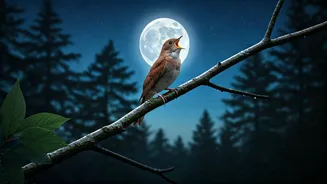
For certain bird species, such as the widely recognized common nightingale, vocalizing during the night is not merely an occasional occurrence but a deeply ingrained aspect of their species' characteristic behavior. These birds are renowned for their elaborate and melodious songs, which they frequently perform under the veil of darkness. While the precise scientific reasons behind this specific nocturnal tendency are still subjects of ongoing research, prevailing theories strongly link it to a dual purpose: reinforcing their territorial claims and actively engaging in mate attraction. This specialized behavior highlights the remarkable diversity in avian communication strategies across different species.
Environmental Triggers
Beyond inherent biological drives, external environmental cues also exert a significant influence on initiating bird vocalizations in the quiet hours. Fluctuations in atmospheric temperature, changes in humidity levels, or even the presence of artificial illumination can all act as prompts for certain birds to sing. For instance, a sudden and noticeable decrease in temperature might trigger a bird to vocalize as a mechanism to conserve body heat or to alert other individuals to its whereabouts within the environment. These external signals demonstrate how birds are attuned to their surroundings, using them to guide their behavior and communication.