





Why Black Holes Matter
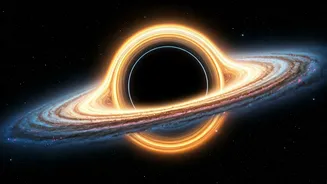
Black holes, often considered the ultimate cosmic vacuum cleaners, play a pivotal role in the universe's grand design. They aren't just fascinating because
of their extreme gravity; they influence the formation and evolution of galaxies. Supermassive black holes, found at the centers of most galaxies, regulate star formation and the overall structure of these galactic systems. The study of black holes provides insights into fundamental physics, particularly general relativity, as the extreme conditions around them push our current understanding to its limits. By observing how black holes interact with their surroundings, scientists can test theories about gravity and the behavior of matter and energy under extreme conditions, potentially revealing new discoveries about the universe. Their gravitational influence affects everything, from the smallest particles to the largest structures, making their study essential to comprehending the cosmos fully.
Supermassive Black Holes
At the heart of nearly every galaxy, including our own Milky Way, lies a supermassive black hole. These cosmic behemoths can have masses millions or even billions of times that of our sun. Their formation remains a subject of active research, but several theories exist. One possibility involves the merging of smaller black holes or the direct collapse of massive gas clouds early in the universe's history. These supermassive black holes dramatically affect their galactic environments. Their immense gravity governs the motion of stars and gas in the galactic center, influencing the overall shape and activity of the galaxy. Additionally, the accretion of matter onto these black holes creates powerful jets of energy and radiation, which can profoundly impact star formation and the distribution of gas within the galaxy. Thus, the study of these objects helps scientists understand how galaxies form and evolve over billions of years.
Intermediate-Mass Black Holes
Intermediate-mass black holes (IMBHs) are a fascinating yet less understood class of black holes, falling in size between stellar-mass black holes and supermassive black holes. Their existence was long predicted, but they have been challenging to detect directly. Scientists have proposed several formation mechanisms, including the merging of smaller black holes, the collapse of massive star clusters, or the accretion of a large amount of matter in a short period. IMBHs are crucial for understanding the overall population of black holes in the universe. They may act as seeds for the growth of supermassive black holes, providing a link between the stellar-mass and supermassive scales. Observing and studying IMBHs helps test models of galaxy formation and evolution. Locating these objects is a complex task, often involving looking for their effects on nearby stars or searching for unusual gravitational wave signals produced by black hole mergers.
Primordial Black Holes
Primordial black holes are a particularly intriguing theoretical concept. Unlike stellar-mass black holes, which form from the collapse of massive stars, primordial black holes are hypothesized to have formed in the very early universe, shortly after the Big Bang. Their formation is believed to be linked to extreme density fluctuations that occurred during the universe's initial expansion. The mass of these primordial black holes could vary significantly, potentially ranging from tiny, microscopic sizes to masses comparable to those of supermassive black holes. If they exist, primordial black holes could have profound implications. They could contribute to dark matter, the mysterious substance that makes up a significant portion of the universe's mass. Their detection would offer a unique window into the conditions of the early universe. Scientists continue to search for evidence of primordial black holes through various methods, including looking for specific gravitational effects and the potential detection of their evaporation signatures, although no definitive discovery has been made to date.
Stellar-Mass Black Holes
Stellar-mass black holes form from the collapse of massive stars at the end of their lives. When a massive star exhausts its nuclear fuel, it can no longer sustain the outward pressure needed to counteract its gravity. The core collapses inward, leading to a supernova explosion and, in many cases, the formation of a black hole. These black holes typically have masses ranging from about 3 to dozens of times that of the sun. They can be found in binary systems, where they orbit a companion star. These binaries are valuable tools for detection, as the black hole's gravity affects the motion of the companion star, providing an indirect method of observation. Furthermore, when the black hole accretes matter from its companion star, it can create a bright accretion disk, emitting intense X-rays, thus making the object even more visible to astronomers. The study of stellar-mass black holes helps scientists understand the life cycle of massive stars and the final stages of stellar evolution.