






Ancient Board Game Intro
The love of board games is deeply rooted in human history, with evidence suggesting that these games were popular across various ancient civilizations.
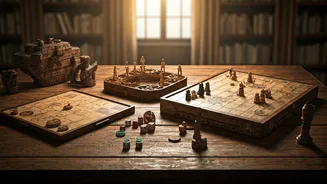
These games weren't just a pastime; they provided social interaction, strategic challenges, and a way to pass time. The games reflect the cultures and the intellectual pursuits of the people who played them. Several games played in the ancient world, like Chaturanga from India and The Royal Game of Ur, show how complex and diverse game design was even thousands of years ago. These games were precursors to many modern board games, influencing strategy, luck, and competition in play. Examining the rules and cultural context of these early board games offers insights into the way people lived, thought, and entertained themselves.
Chaturanga: Indian Origins
Chaturanga, which originated in India, is a highly significant game in the history of board games. The game is seen as a direct ancestor of chess. Chaturanga developed in the 6th century, and it includes the basic pieces like the king, the chariot (rook), the elephant (bishop), the horse (knight), and the pawn (soldier). Chaturanga provided an early blueprint for strategic thinking in board games. This game was more than a pastime; it was an exercise in military strategy, mirroring warfare tactics of the time. The strategic depth of Chaturanga spread across Asia and eventually evolved into different versions that led to chess. Its influence is also seen in other strategic games, showcasing the lasting impact of this early Indian board game.
The Royal Game of Ur
The Royal Game of Ur, which dates back to ancient Mesopotamia around 2600–2400 BC, is one of the oldest board games ever discovered. Unearthed in the Royal Tombs of Ur in modern-day Iraq, the game's artifact includes a beautifully decorated board and game pieces. The game blends elements of chance and strategy. Players roll dice to determine their moves, and their goal is to advance their pieces across the board. The Royal Game of Ur was enjoyed by people from all walks of life, including royalty. It gives us a fascinating look into the social dynamics and leisure activities of one of the earliest civilizations.
Senet: Ancient Egyptian Game
Senet, an ancient Egyptian game, dates back to around 3100 BC, making it one of the earliest known board games. This game reflects the Egyptian belief in the afterlife, with the journey of the game possibly symbolizing the passage through the afterlife. Senet was played with a board consisting of 30 squares arranged in three rows of ten. Players used a set of pieces and throwing sticks to navigate the board. Over time, Senet evolved, gaining religious significance, and became a symbol of the soul's journey after death. The game's presence in tombs and its illustrations show its association with Egyptian religious beliefs and the afterlife, making it more than a mere game.
Mancala: Global Tradition
Mancala, or 'sowing' games, represents a family of board games with ancient roots, spread across the globe with various regional versions. The core of Mancala involves scooping seeds from pits and redistributing them into other pits, aiming to capture the most seeds. These games are popular in Africa, the Middle East, and Asia. Evidence suggests that Mancala may be one of the oldest games played worldwide. The game's widespread presence reflects different cultures adopting and adapting the game. From the simple rules to strategic depth, Mancala games continue to engage people of all ages.
Patolli: Aztec Strategy
Patolli, a game of strategy, was significant in Aztec civilization, serving not only as entertainment but also as a cultural and religious practice. The game board often resembles a cross, with specific markings and areas where players navigate their pieces. Players threw beans that functioned as dice to determine their movements. Patolli was associated with gambling and ritualistic activities. The significance of Patolli in Aztec society illustrates how games can be deeply woven into the cultural, religious, and economic life of a civilization. From the materials used to create the board and pieces to the social contexts in which it was played, the game offers a window into the customs and belief systems of the Aztecs.