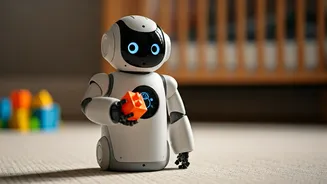







The Rise of AI Companions
The integration of Artificial Intelligence into children's toys is creating a new category of interactive playthings, ranging from conversational bots
to devices that sense emotions. While these innovations aim to enhance engagement and learning, a significant debate is emerging around their suitability for young minds. Jo Barnard, a prominent designer and advocate for mindful AI, raises crucial questions about the potential consequences of children forming relationships with non-human entities. She stresses that children are in critical stages of social and cognitive growth, absorbing information and behaviours rapidly without the ability for critical evaluation. This vulnerability means that interactions with AI, which often struggle with nuanced language and context, could have unintended and significant impacts on how children understand the world and their place within it. Barnard's work through the Mindful AI initiative emphasizes a deliberate and child-centric approach to designing technology, prioritizing restraint and a deep understanding of developmental needs over simply incorporating the latest AI capabilities.
Emotional Misinterpretations and Attachment
A significant concern with AI toys is their proficiency in interpreting and responding to a child's emotions. Research has highlighted instances where AI systems misjudge a child's distress or provide inadequate reactions, potentially leading to confusion and hindering social development. Barnard points out that intelligence devoid of true context can be detrimental. Conversely, an AI that is overly empathetic might offer constant validation, which isn't always beneficial for a child's learning process. Children experience a wide spectrum of emotions and need to learn to navigate them, not just receive perpetual affirmation. Furthermore, AI companions are designed to be endlessly patient and agreeable, unlike human relationships. This persistent positivity can create unrealistic expectations for real-world interactions, where conflict and disagreement are natural. The potential for unhealthy attachment to a readily available, non-judgmental AI entity is a considerable risk, as it might disincentivize children from developing the resilience and social skills needed for genuine human connection.
Cognitive Development Risks
Beyond emotional impacts, AI toys pose considerable risks to children's cognitive development. Many of these toys are engineered to maximize user engagement, which can foster a sense of dependency, making it difficult for children to disengage. This constant interaction can lead to a significant reduction in cognitive effort. For developing brains, this offloading of thinking processes means that crucial cognitive abilities may not fully form. Barnard likens this to muscles that don't get exercised – they weaken and fail to develop. The inherent inability of AI to fully grasp the complex, nuanced context of the real world, known as the 'context gap,' means its guidance and responses are often incomplete or inappropriate. This lack of rich, lived experience limits the opportunities for children to engage in creative problem-solving and independent thought, which are vital components of a healthy childhood. The design of these toys, often focused on capturing and holding attention, works against the development of sustained focus and self-directed learning.
Mindful Design Principles
Addressing the challenges presented by AI toys requires a fundamental shift in design philosophy, moving away from maximizing engagement towards intentional and bounded experiences. Barnard advocates for the creation of 'Mindful AI' concepts, which involve developing AI applications that support children's development in a controlled and beneficial manner. Examples include AI tools that generate creative prompts for children to elaborate on, or systems that encourage family discussions rather than individual, isolating interactions. These designs deliberately limit the scope of AI's influence, aiming to add an element of wonder and support without overwhelming or replacing essential human interactions. The current trend of AI toys competing for attention in a crowded market risks overstimulation and attachment, mirroring the negative consequences observed with social media, such as diminished attention spans and potential addiction. Barnard suggests that without careful oversight, regulatory bans on certain AI toys might become necessary, similar to measures taken for other concerning technologies.
Shared Responsibility and Transparency
Ensuring the safety and responsible development of AI toys is a shared responsibility that cannot fall solely on parents, who often lack the technical expertise to fully understand the implications. Barnard stresses that developers, being the most knowledgeable about the technology, must take the lead in establishing clear industry standards in collaboration with regulators. Transparency regarding data collection is paramount; companies must openly disclose what data is collected, how it is used, and with whom it is shared. This includes voice recordings and usage patterns. Parents are urged to conduct thorough research before purchasing AI toys, scrutinizing privacy policies and understanding third-party integrations. Ultimately, the goal is not to eliminate AI from children's lives but to harness its potential thoughtfully. The aim is for AI to act as a supportive intelligence that enhances children's creativity, calm, and agency, rather than fostering dependency and displacing crucial human relationships. The current generation of 'AI natives' needs these tools to complement their growth, not substitute for it.