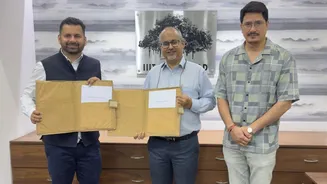









From HCL to Helping Hands
Vineet Nayar's transition from leading HCL Technologies to founding the Sampark Foundation wasn't a retreat from challenges, but a shift to a different,
equally significant transformation: improving primary education at scale. His journey was spurred by a personal realization about finding life's true meaning through contributing to others' goals, a sentiment echoed by his mother's dedication as a government school teacher. The foundation, co-established with his wife Anupama Nayar, initially explored several sectors like health and agriculture before zeroing in on education due to its immense potential for widespread impact. Reaching 20 million children across 200,000 government schools through partnerships with eight state governments, Sampark Foundation embodies a mission to create scalable learning systems for India, not merely distribute aid.
Empowering Teachers, Amplifying Learning
Drawing from his HCL experience, Nayar emphasizes that technology amplifies human potential rather than replacing it. He learned that systemic change hinges on empowering frontline workers, in education's case, the teachers. Instead of viewing teachers as the problem, Sampark focuses on equipping them for success and simplifying classroom complexities. This approach is crucial for addressing the reality of rural Indian classrooms, which often suffer from compliance-driven systems, overburdened teachers, and a disconnect between boardroom solutions and ground realities. Innovations are designed with scale, affordability, and simplicity in mind, ensuring they can be implemented across millions of students. The importance of robust feedback loops and data-driven accountability is paramount, transforming systems from drifting entities to continuously improving ones.
Sampark TV: Smart Classrooms, No Internet
Sampark TV represents a practical application of technology for rural education, designed to function without constant internet access. This system, integrated with Android devices and smart boards, presents curriculum content in a 'Netflix-style' interface, aligned with state textbooks. Its pedagogical approach focuses on structured teaching of microconcepts through lesson plans, animated videos, and gamified assessments, all managed by the teacher. Crucially, Sampark TV incorporates an AI engine that collects and transmits classroom data, providing daily insights to government agencies. This unprecedented visibility allows administrators to track teaching adherence and student engagement, while the teacher shifts from being the sole instructor to a learning facilitator. The foundation firmly opposes providing devices directly to children, advocating for the teacher to retain control of the screen, a model currently active in 86,000 classrooms.
AI for Optimal Learning Paths
Sampark AI is a sophisticated engine designed to chart the most effective learning trajectories for individual microconcepts. By capturing real-time data on teacher instruction and student responses through the Android device, it feeds valuable insights into a central AI engine. This data then populates dashboards for government administrators, highlighting progress and areas needing attention. Beyond administrative oversight, Sampark AI facilitates periodic assessments to gauge actual learning outcomes. Individual student performance is tracked through various methods. Initial assessment involves visually identifying correct answers within the classroom. Further, Sampark staff capture images of student workbooks, which AI then analyzes to pinpoint correct and incorrect responses, generating granular assessment data for each child.
Lessons from Harvard's Lens
Sampark Foundation's innovative approach to social transformation has garnered attention, leading to case studies at Harvard Business School. These studies delve into the critical question of whether large-scale social change can be achieved with the same level of rigor, creativity, and accountability typically seen in the corporate sector. The cases illustrate how Sampark masterfully combines technology, behavioral science, disciplined operations, and robust government partnerships to build educational systems that are both scalable and effective. Furthermore, Sampark Foundation's methodologies are recognized in Harvard professor Linda Hill's book, 'Genius at Scale,' featuring among ten prominent cases that showcase groundbreaking approaches to large-scale impact.
Rural Education: Beyond Tech Fixes
Vineet Nayar posits that the challenges in rural Indian education are fundamentally rooted in systemic and human capability issues, rather than being solely a technology problem. While technology can significantly boost outcomes when used judiciously, it cannot substitute for crucial elements like motivation, teacher commitment, leadership, or community involvement. He critiques the common misconception that distributing devices automatically equates to educational reform, asserting that a tablet devoid of effective pedagogy is merely hardware. Crucially, India must resist blindly adopting Western educational models. Solutions must be meticulously crafted to accommodate multilingual classrooms, environments with limited infrastructure, and students who are often first-generation learners, ensuring relevance and efficacy within the Indian context.
Tech Pitfalls in Indian Education
Nayar identifies three primary technological interventions that have historically faltered within the Indian educational landscape. Firstly, a pervasive 'hardware-led' mindset, where the belief that merely providing tablets and computers would enhance learning proved unfounded. Secondly, reliance on internet-dependent models has been a significant drawback, as consistent connectivity remains an elusive reality in many rural areas. Finally, the ill-advised importation of urban-centric edtech solutions into rural government schools has consistently failed. These products, typically designed for affluent, English-speaking demographics, have crumbled when confronted with the distinct realities of rural India, demonstrating a critical disconnect in application and suitability.
Navigating AI's Ethical Frontier
The proliferation of AI companies, driven by subscription models and user acquisition, presents significant concerns for educational ecosystems. Nayar highlights that despite AI's known capacity for factual inaccuracies and 'hallucinations,' these tools are increasingly being placed in children's hands, potentially shaping their understanding of history, geography, and critical thinking over years. Companies prioritize subscriber growth, which inflates their valuations, and the initial free availability of these AI products makes them attractive to state governments. A critical danger lies in data harvesting: AI engines are trained on Indian data, potentially creating dependence and phasing out viable alternatives once subscriptions are introduced. This mirrors past situations where dominant operating systems replaced local alternatives due to widespread availability, suggesting a risk of creating a similar dependency in education, ultimately benefiting edtech companies at the expense of sustainable, localized solutions.
Teacher-Centric AI: The Right Approach
Given the unique challenges of rural Indian classrooms—multigrade settings, diverse languages, inconsistent attendance, and significant administrative burdens on teachers—technology must serve as a supportive tool for educators, not isolate students. Nayar strongly advocates for keeping devices, like iPads, under the teacher's control, rather than placing them directly into children's hands. This teacher-centric approach ensures technology enhances instructional delivery and classroom management. He draws a parallel to the 'Free Basics' debate, where robust scrutiny was applied to Facebook's proposed free internet access, urging policymakers to apply similar vigilance to AI-driven educational models to prevent potential exploitation and ensure equitable access.
Startups and Social Impact
Vineet Nayar actively mentors 19 startups, many of which are leveraging AI and advanced technologies to address critical business and social issues. His mentorship focuses on identifying solutions for teacher productivity, personalized learning, employee assessment, operational efficiency, healthcare, financial models, drug discovery, and human capability enhancement. In education, key opportunities lie in foundational learning, multilingual AI systems, adaptive learning platforms, and robust teacher enablement tools, alongside low-cost, scalable infrastructure. Nayar's mentoring process prioritizes understanding the core use case, confirming that benefits reach the end-user, and validating the meaningful integration of technology. He remains impartial to whether a startup is for-profit or not-for-profit, focusing solely on the impact and innovation.