






The Ordeal Begins
A recent incident involving an Indian traveler underscores a potentially frustrating travel scenario in Southeast Asia. While attempting to fly from Laos
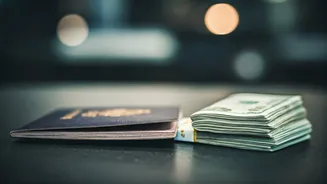
back to Cambodia, the individual, originally from Visakhapatnam, was unexpectedly barred from boarding by airline officials. The demand was explicit: present 400 US dollars in cash as proof of funds. Despite having successfully entered Cambodia just two weeks prior using a credit card for a visa on arrival after flying from Bangkok, this traveler found herself in a challenging situation. She recounted this experience on Instagram, advising fellow Indian travelers to carry a moderate amount of cash to preempt such demands, which she felt were humiliating and indicative of being perceived as an 'illegal person' rather than a tourist. She emphasized that even presenting a bank statement, her travel history, and prior successful card payments did not sway the airline staff, who cited a vague rule, allegedly communicated via a private messaging group.
Broader Traveler Experiences
Following the initial traveler's account, other individuals shared similar encounters, revealing this issue is not isolated. One user reported being asked to show $800 in cash when flying from Bangkok to Cambodia, contrasting their experience with that of a Chinese tourist who was reportedly allowed to proceed without showing cash. Another traveler from China corroborated the scrutiny, mentioning requests for $500 in cash when flying from Cambodia to Thailand and $300 when traveling from Thailand to Cambodia. Immigration officials in Laos were also cited for demanding the purchase of a return flight ticket, irrespective of border crossing plans, due to concerns about illegal entry and employment. These shared experiences suggest a pattern of intensified scrutiny for travelers, particularly those of certain nationalities, at various transit and entry points within the region.
Official Regulations vs. Reality
Official guidance from the Indian Ministry of External Affairs website lists Cambodia as a country offering visa-on-arrival for Indian nationals. The stated requirements include confirmed accommodation and return flight tickets. While the website notes that Cambodian Immigration Police 'may ask to show some cash in USD (minimum USD 500$ for each passenger)', the criterion for Laos is notably blank. This discrepancy between official advisories and the on-the-ground experiences of travelers highlights a potential gap. The MEA's information suggests that proof of funds, including cash, is a possibility, but the specific amount and the strictness of its enforcement appear to vary and can be subject to interpretation by immigration and airline personnel, leading to unexpected difficulties for genuine tourists.
Expert Insights on Proof of Funds
G.S. Bawa, Secretary General of the Air Travellers Association and former GM of the Airports Authority of India, clarifies the situation regarding cash requirements for travel. He states that there isn't a universally mandated official law requiring travelers to carry a precise amount like $400 in cash. However, he confirms that immigration officers, particularly in countries like Cambodia, may indeed request proof of sufficient funds to support a tourist's stay. This proof can encompass cash, credit cards, or bank statements. Bawa acknowledges reports suggesting that individuals from specific nationalities might be asked to demonstrate funds ranging from $500 to $1000, though this is not a rigid, universally applied rule. He advises travelers to carry some US dollars, possess accessible bank statements or credit cards, and ensure any cash presented is in good condition, as damaged notes are often rejected.
Navigating International Travel
According to Bawa, countries implement entry requirements based on their experiences with different traveler demographics and types of visitors, often aiming to protect their own interests and those of genuine tourists. He emphasizes the importance of transparent and well-publicized travel regulations to minimize inconvenience. Clear communication about what travelers should and should not do when entering a country is crucial. Bawa also points out that in nations where digital transactions are less prevalent, cash might be the preferred or demanded method of proving financial capability. Strategic planning encompassing visa requirements, immigration procedures, and currency management is essential for a smooth international travel experience. Travelers are advised to be prepared for potential demands for proof of funds, even if not explicitly stated in all official documentation.