



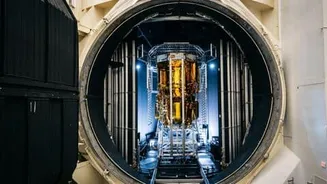
Endurance Passes Space Test
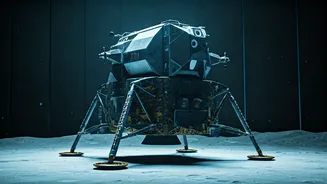
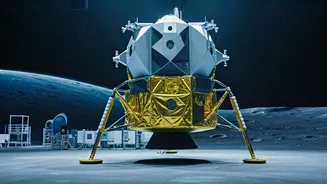
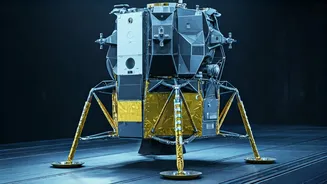
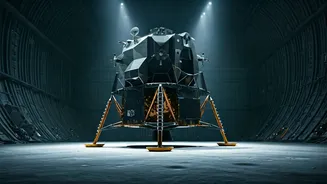
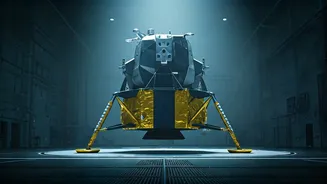
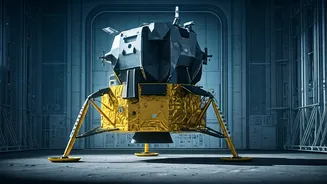
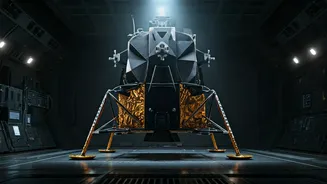
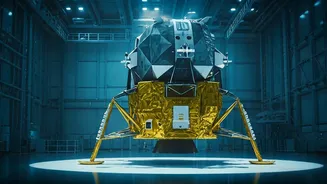
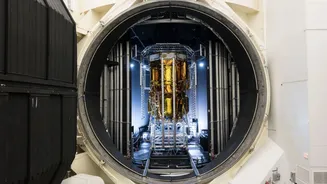
Blue Origin has successfully completed a significant phase of testing for its 'Endurance' lunar lander, also known as Blue Moon Mark 1 (MK1). This critical
testing took place within the specialized confines of a vacuum chamber at NASA's Johnson Space Center, a crucial milestone for upcoming lunar missions. The 'Endurance' spacecraft was subjected to extreme conditions that replicate those encountered in space, including frigid temperatures and near-vacuum atmospheric pressures. The primary objective of this rigorous testing was to validate the lander's ability to withstand the harsh space environment and to ensure its operational readiness for a journey to the Moon. Engineers meticulously recreated the environmental challenges the lander will face en route to its lunar destination. This terrestrial validation focused on confirming the integrity of the lander's structural components, the efficacy of its thermal management systems, and its overall performance characteristics, all essential for a successful lunar deployment. The collaborative effort between NASA and Blue Origin, formalized through a Space Act Agreement, underscores the synergy driving advancements in space exploration.
MK1: Unmanned Lunar Delivery
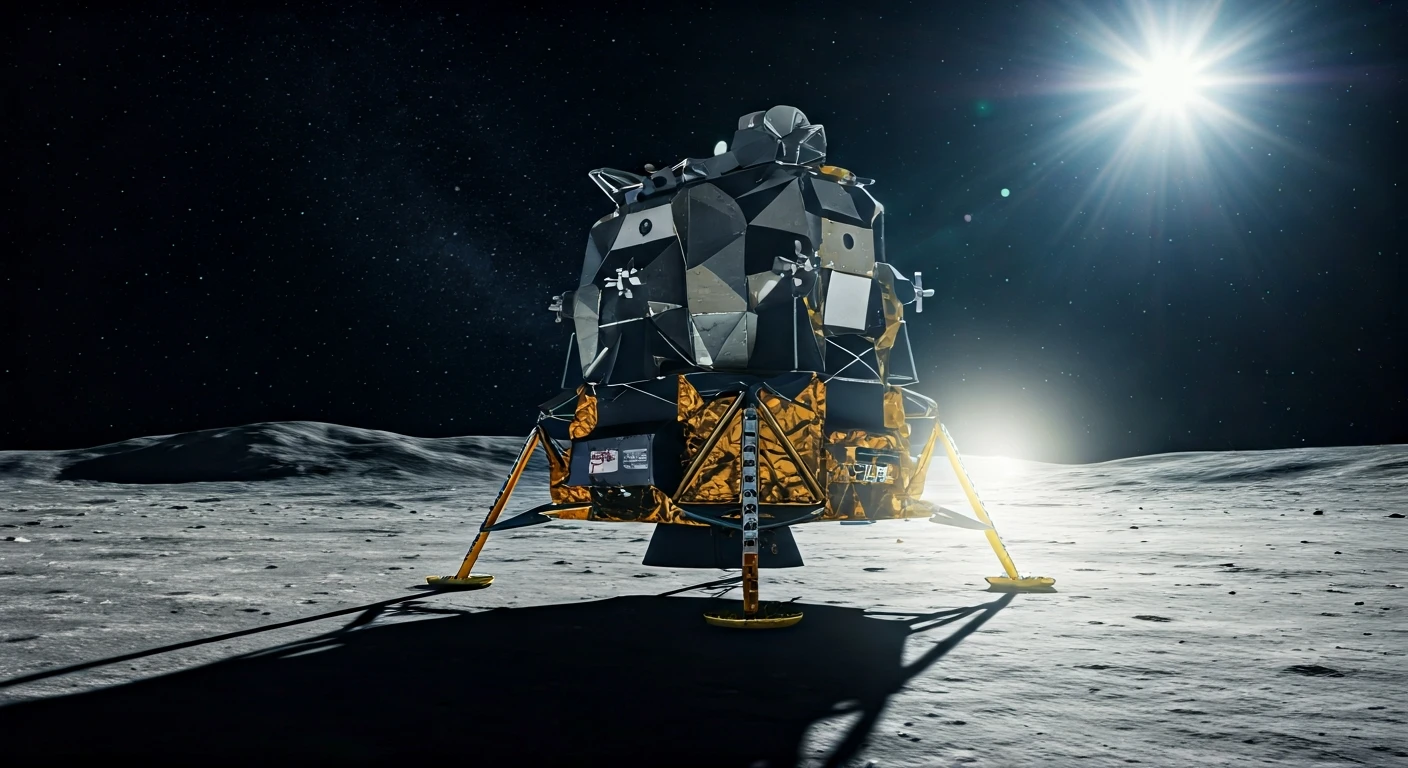
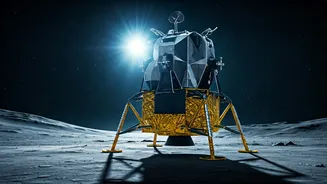
The Blue Moon MK1, affectionately nicknamed 'Endurance,' is designed as an uncrewed spacecraft dedicated to transporting vital cargo and equipment to the lunar surface. This robotic craft plays an integral role in fulfilling the ambitious objectives set forth by NASA's Artemis program. The MK1's primary mission is to showcase and validate several key technologies essential for achieving a successful landing on the Moon. These capabilities include precision landing techniques, the efficient utilization of cryogenic propellant systems for propulsion, and the autonomous execution of guidance, navigation, and control functions. The intended landing site for the MK1 is the lunar south pole, an area of significant scientific interest due to its potential for supporting future human outposts. This region is particularly promising because it is believed to harbor water ice, a resource that could be invaluable for sustaining future missions and establishing a long-term human presence. Beyond its own investigative tasks, the MK1 will also host and deploy several scientific experiments, including the Stereo Cameras for Lunar Plume-Surface Studies, which will capture detailed imagery of engine plume interactions with the lunar regolith during descent. Additionally, it will deploy a Laser Retroreflective Array.
Foundation for Human Missions
While the MK1 is specifically a cargo delivery mission, its significance extends far beyond its immediate payload. The technologies being developed and validated with the MK1 are foundational for the subsequent development of Blue Origin's Mark 2 (MK2) lander. This larger, crew-rated vehicle is being engineered to facilitate the transportation of astronauts between lunar orbit and the Moon's surface. The invaluable data and operational experience gained from the design, testing, and eventual deployment of the MK1 will directly enhance the safety, reliability, and overall mission planning strategies for future human landings. This iterative approach, leveraging unmanned missions to refine capabilities before introducing human crews, is a cornerstone of robust space exploration programs. By proving these technologies on a smaller scale, the risks associated with more complex human expeditions are significantly mitigated, ensuring a smoother and safer path to establishing a sustained human presence on the Moon.
Pathway to Lunar Presence
The collaborative approach between NASA and private entities like Blue Origin is a strategic enabler for accelerating lunar exploration. By leveraging NASA's extensive resources and expertise, private companies can expedite their development timelines without compromising on the stringent safety standards required for space missions. Now that the rigorous environmental testing phase for the Blue Moon MK1 has been successfully concluded, the lander has taken a substantial leap forward in its journey toward becoming a fully operational asset. This accomplishment marks a crucial step in the broader objective of establishing a sustainable human presence on the Moon. The successful validation of the MK1's systems and capabilities provides a solid foundation for future lunar endeavors, including the development of more sophisticated landers and infrastructure necessary for long-term habitation and scientific research. This partnership model is proving to be highly effective in pushing the boundaries of what's possible in space exploration.