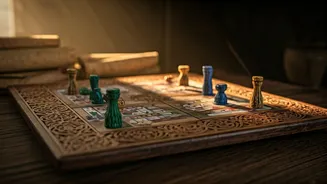







Chaturanga: Origins And Strategy
Chaturanga, which originated in India, is widely considered the precursor to modern chess. Played on an 8x8 board, it involved four players initially,
each commanding different pieces with unique movement capabilities. The game's objective revolved around checkmating the opponent's king, simulating a battlefield scenario. Chaturanga's strategic depth and complexity mirrored real-world warfare tactics of the time. This strategic game spread throughout Asia, evolving into various forms like Xiangqi in China and Shogi in Japan. The core concepts of Chaturanga, such as the strategic arrangement of pieces, the value of each unit, and the objective of capturing the opponent's most powerful piece, laid the foundation for the globally popular game of chess. Understanding Chaturanga provides invaluable context into the evolution of strategy board games.
The Royal Game Of Ur
Dating back to ancient Mesopotamia, The Royal Game of Ur is another intriguing board game with an incredibly rich history. Unearthed in the Royal Tombs of Ur, this game featured a board with a distinctive pattern of squares and rosettes. The gameplay involved rolling dice to determine the movement of pieces across the board, aiming to reach a specific destination. The game incorporated elements of chance and strategic decision-making, as players had to navigate obstacles and outmaneuver their rivals. The Royal Game of Ur provided entertainment and fostered social interaction among the Mesopotamians. The game also included a layer of chance with its dice rolling mechanic, and this is still seen in many modern games. Despite its age, the fundamental elements of The Royal Game of Ur are still present in modern-day games.
Pachisi: The Cross and Dice
Pachisi, another prominent Indian game, is often known as the 'Game of the Cross'. It's characterized by its large board shaped like a cross and the use of dice or cowrie shells to determine movement. Pachisi is a race game in which players compete to move their pieces, known as pawns, around the board to the central space. The game's vibrant colors and social dimension highlight its significance. Pachisi's appeal lies in its combination of chance and strategic decisions. Pachisi is still played in India today, and has inspired numerous modern games. The game’s focus on teamwork and chance-driven mechanics allowed people to connect and enjoy themselves in a lighthearted atmosphere. The game's popularity demonstrates the enduring appeal of traditional board games.
Senet: Egypt's Game
Senet, an ancient Egyptian board game, holds a place of honor within the historical context. Discovered in pharaoh's tombs, the game symbolizes the journey of the soul through the afterlife. Its rectangular board features 30 squares divided into three rows. The gameplay includes rolling dice to move pieces, navigating various challenges. Senet's strategic depth and cultural relevance reflect the beliefs and societal values of ancient Egypt. The game also incorporates elements of chance. Senet provides a unique look at how the ancient Egyptians approached the themes of life, death, and the afterlife. Senet's enduring legacy highlights the importance of the game.
Go: China's Strategic Game
Go, originating in ancient China, stands as a testament to strategic complexity and thoughtful decision-making. Two players compete by placing black and white stones on a grid-like board to surround the territory. The goal is to control a larger area than the opponent. Go's intricate rules and profound depth have captivated minds for centuries. Go's abstract simplicity and strategic depth make it an enduring game. The game requires forward-thinking and tactical planning. Go's enduring popularity across the globe makes it a great game to play.