






Chilling Atoms
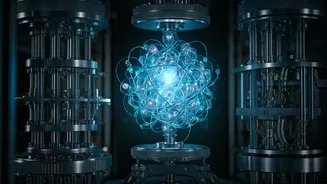
To understand the potential of quantum technology, one must begin with the concept of ultracold atoms. These aren't just any atoms; they are cooled to temperatures
incredibly close to absolute zero. This extreme cooling is not a freezing process in the traditional sense, but rather a sophisticated technique to slow down the atoms' movement drastically. The objective is to bring these atoms to a near standstill, allowing scientists to study their quantum properties with unprecedented precision. As these atoms become colder, they begin to exhibit quantum behaviors, which are governed by the strange laws of quantum mechanics. This opens doors to a deeper understanding of the universe and the potential for technological breakthroughs.
Quantum Precision Tools
One of the most remarkable applications of ultracold atoms lies in the creation of the world's best clocks. These atomic clocks are not the clocks one might find in their everyday lives. Instead, they are based on the precise oscillations of atoms. Because atoms at ultracold temperatures oscillate in a very predictable way, they can be used as a measure of time with incredible accuracy. This atomic precision is essential in fields like navigation, telecommunications, and fundamental physics research. Atomic clocks based on ultracold atoms have the potential to make these existing technologies even better, as well as opening up new avenues for quantum technologies.
India's Scientific Footprint
India is making its mark in ultracold-atom physics, with researchers across the country contributing to the field's advancement. Scientists in India are working on developing and refining techniques to create and control ultracold atoms, focusing on building experimental setups and conducting theoretical research. This work positions India as a growing force in this cutting-edge area of research. In addition to basic research, Indian scientists are exploring practical applications of ultracold atoms, paving the way for innovations in quantum technology and contributing to the global effort to harness the quantum world's potential. This active involvement in research underscores India's commitment to advancing scientific and technological capabilities.
Quantum Computing's Future
The field of quantum computing stands to benefit greatly from the study of ultracold atoms. Ultracold atoms could function as qubits, the basic units of quantum computers. The ability to manipulate and control the quantum states of these atoms with extreme precision makes them ideal candidates for building quantum computers. Quantum computers, if successfully developed, promise to outperform even the most powerful supercomputers in specific tasks, potentially revolutionizing areas such as drug discovery, materials science, and artificial intelligence. The use of ultracold atoms in quantum computing is still in its infancy, but it offers a promising path towards unlocking the immense power of quantum computation.
Nanotechnology Integration
Ultracold atoms are also being combined with nanotechnology to create new possibilities. Nanotechnology, dealing with materials on the nanometer scale, is allowing scientists to build and control atom-sized structures. The combination of ultracold atoms and nanotechnology could lead to new types of sensors and materials with properties not achievable through conventional methods. This convergence opens the door to creating new types of quantum devices, and this collaboration between nanotechnology and ultracold atoms demonstrates the interdisciplinary nature of modern scientific research. The combination of both fields could lead to a wide variety of technologies that have the potential to change daily life.