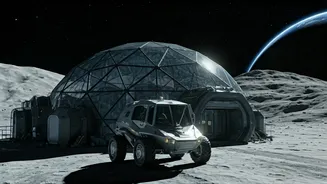

A Lunar Observatory
NASA's investigation into the origins of water on Earth has turned towards the Moon, a natural satellite of profound scientific significance. The Moon, offering
a unique geological history, holds vital clues to the mysteries of our planet. This bold initiative entails utilizing the Moon as a crucial laboratory for studying the origins of water. By thoroughly examining the lunar regolith and utilizing advanced instrumentation, NASA hopes to uncover the origins of the water. The project's overall goal is to understand how water, an indispensable element for life, arrived on Earth, providing insights into the genesis of our oceans and the conditions that fostered life.
Analyzing Lunar Samples
One primary method in NASA's approach involves detailed examinations of lunar samples, acquired throughout the Apollo missions and subsequently. These samples, which have been preserved in specific conditions, provide a glimpse into the Moon's past. The examination, undertaken using cutting-edge analytical tools, focuses on the detection and characterization of water molecules or traces. Scientists investigate the isotopic composition of the hydrogen found in these samples. The proportion of deuterium, a heavier isotope of hydrogen, offers crucial insight into the water's origin. By contrasting the isotopic signatures of lunar water with that of water on Earth, researchers hope to determine if they share a common source, or if they originated from external sources such as asteroids or comets.
Unveiling Water Sources
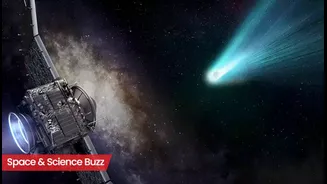
NASA's investigation is not only limited to analyzing lunar samples; it also uses a variety of methods to trace potential water sources. The agency has deployed sophisticated instruments on the Moon, like the Lunar Reconnaissance Orbiter (LRO), to remotely detect water ice in permanently shadowed areas, particularly near the lunar poles. These ice deposits could hold invaluable clues about the delivery of water to the Earth. Asteroids and comets, which are rich in water ice, have been proposed as delivery agents, depositing their water onto the young Earth through numerous collisions. By studying the chemical makeup of these icy bodies and comparing it with the lunar and terrestrial water, scientists seek to pinpoint the exact origin and the mechanisms behind water's arrival on Earth.
Technology and Innovation
The success of NASA's mission depends heavily on technological advancements. The agency has been investing in innovative technologies such as advanced spectrometers and mass spectrometers to identify and analyze water molecules in lunar samples. These instruments are designed to detect minute traces of water and to determine their isotopic compositions. Furthermore, NASA is developing robotic missions, like the Volatiles Investigating Polar Exploration Rover (VIPER), to explore the lunar surface and analyze water ice in previously inaccessible locations. These missions will not only help in mapping water ice deposits but also in collecting data on their physical properties and chemical compositions, thereby furthering our comprehension of water's distribution and origin. The combination of cutting-edge technology and innovative mission planning represents NASA's commitment to unraveling the mystery of Earth's water.
Significance of Research
The effort to study the origins of water on Earth has significant implications for our understanding of the universe and the quest to find habitable worlds. By tracing the water's source and understanding how it reached Earth, scientists can better understand the circumstances that allowed life to develop. Water is a key element for all known life, so understanding its origins helps in establishing what conditions are necessary for life to arise elsewhere in the cosmos. Moreover, the Moon serves as a stepping stone for the exploration of space and a potential resource for future space missions. The water discovered on the Moon can be used for life support systems and fuel production, potentially making lunar missions more sustainable.