






Gemini Enterprise Agents
Google Cloud is launching a comprehensive Gemini Enterprise Agent Platform, acting as a unified hub for businesses to construct, deploy, govern, and refine
autonomous AI agents. This platform empowers technical teams by offering flexibility in model selection, allowing them to utilize existing models like Gemini 3.1 Pro, Gemini 3.1 Flash Image (Nano Banana 2), and Lyria 3, as well as integrating third-party models such as Anthropic's Claude Opus 4.7 and its Sonnet and Haiku variants. The platform is engineered with advanced features for agent integration, DevOps practices, orchestration, and robust security protocols. This ensures that employees can smoothly implement agents via the Gemini Enterprise app while maintaining stringent control, governance, and security measures at scale. The CEO of Google Cloud emphasized that this is not about assembling disparate services but providing a vertically optimized, co-developed stack designed for the immense scale and efficiency demanded by the current era of production AI. This infrastructure, comprising the AI Hypercomputer for scalability, the Data Cloud for contextual understanding, Agentic Defense for protection, and the Agent Platform for orchestration, is presented as the foundational technology for businesses to build their growth engines.
Next-Gen TPUs Arrive
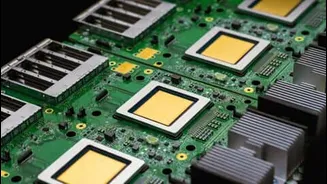
The latest iteration of Google's custom Tensor Processor Unit (TPU) technology has been unveiled with the 8th generation. This new lineup features two specialized architectures: TPU 8t for training and TPU 8i for inference, both meticulously engineered to facilitate the development of highly capable AI models, manage extensive AI agent networks, and handle complex reasoning tasks. The TPU 8t is designed for efficient training of advanced AI models within weeks, balancing high computational throughput, shared memory access, and inter-chip bandwidth with optimal power efficiency and productive processing time. In contrast, the TPU 8i boasts a significant upgrade with 288 GB of high-bandwidth memory and 384 MB on-chip SRAM, a threefold increase from its predecessor. This enhanced memory capacity enables faster task delegation and response times, allowing agents to operate using solely on-chip memory for quick processing, reportedly delivering responses in under five seconds. Both TPU models are slated for general availability later this year, underscoring Google's ongoing efforts to position its TPUs as a compelling alternative to the prevalent GPU market.
AI-Powered Security
Google Cloud is bolstering its cybersecurity defenses with the introduction of three new AI-powered security agents aimed at protecting businesses from sophisticated, AI-driven attacks. The 'Dark Web Intelligence' agent leverages Gemini models and the expertise of Google's Threat Intelligence Group to construct a security profile for an organization. By analyzing millions of daily dark web events with remarkable 98% accuracy, it filters out irrelevant noise to highlight only pertinent threats. The 'Threat Hunting Agent' utilizes Google's internal threat intelligence knowledge, empowering security teams to proactively discover novel attack patterns and adversary behaviors that might evade conventional security measures. Complementing these is the 'Detection Engineering Agent,' designed to automate the creation of persistent detection rules for various threat scenarios, transforming a traditionally manual process into an automated one. Furthermore, to combat unauthorized bot activity, Google is integrating reCAPTCHA into Google Cloud Fraud Defense, a platform dedicated to differentiating between legitimate human users, bots, and authorized agents. Fraud Defense will soon incorporate agentic AI capabilities to secure the entire digital commerce journey, from account creation and login through to payment and checkout.