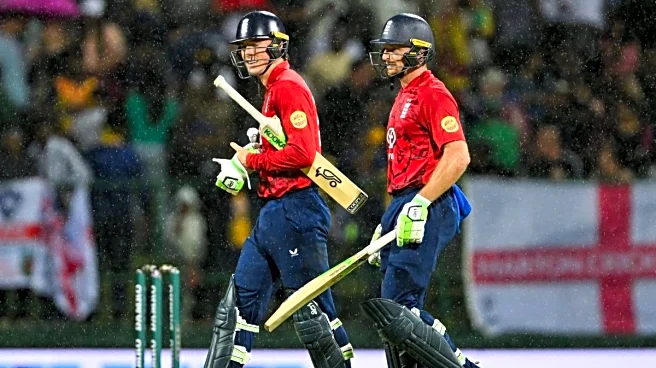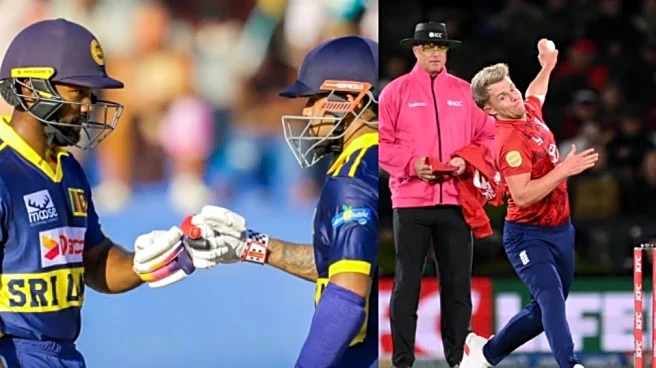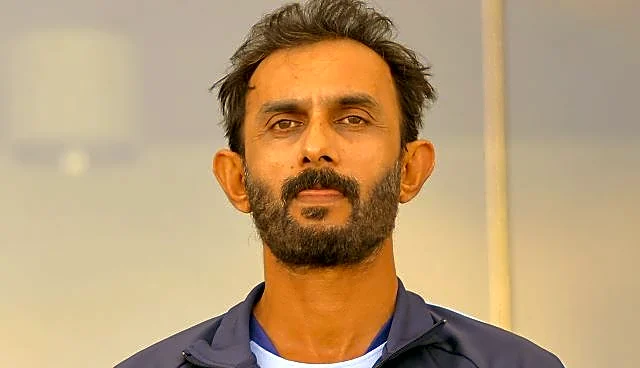




Sri Lanka may have ended on the wrong side of the result in their home T20I series against England, but batting coach Vikram Rathour believes the team’s batting unit is gradually moving towards right direction.
The hosts suffered a six-wicket defeat in a rain-curtailed match in Pallekele on Sunday, yet Rathour felt there were visible signs of improvement. Reflecting on the final game, Rathour highlighted better intent and improved decision-making, particularly against spin.
"I think we were better
today definitely, we showed better intent, better decision against spin. So yeah, it is a work in progress, but we are getting better definitely," Rathour said after the game.
Before rain interrupted England’s chase, Sri Lanka had completed their 20 overs and posted 189 for 5 - only their fifth T20I total above 180 since the conclusion of the 2024 T20 World Cup. While questions have been raised about the side’s lack of power-hitting, Rathour attributed that partly to the nature of pitches Sri Lanka.
"I would say the surfaces here are not that conducive to power hitting as well. Especially when you play in Colombo, it is not an easy surface to hit sixes because it is pretty slow and the ball does not come on to the bat I think there are two components to T20 batting. One is power hitting of course… the other component, or as important a component, is range as a batting unit. I think that is where Sri Lanka can excel," Rathour explained.
The former India batting coach expanded on the idea, pointing out that fours can be just as effective as sixes if batters are smart with shot selection.
"If you are not a power hitter the team that hits a lot of sixes you can hit a lot of fours if you utilise the whole ground. All of them sweep well, most of them can reverse sweep, they use their feet. That is a good thing. If you are not having the power hitting range, then if you can start utilising the whole ground, all the angles, you can make up for that. These wickets maybe suit the batters to do that more. If they can use their feet and use the angles well and score runs square of the wicket, that is as good," he said.
One player who stood out in that regard was 23-year-old Pavan Rathnayake. Entering the match with a modest strike rate of 100 across 35 T20 appearances, Rathnayake delivered a timely 40 off 22 balls to revive Sri Lanka’s innings.
"He is batting really well at the moment, so one of the better players as far as the using of feet is concerned, I think. I haven't seen too many players in this generation using their feet as well as he is doing, so that is really impressive. He again batted well today, so good sign for Sri Lankan cricket I think." Rathour said.
Rathour also threw his support behind captain Dasun Shanaka, who was promoted to No.5 in an attempt to give him more freedom. The move did not pay off on the day, with Shanaka falling early to an Adil Rashid googly, but Rathour insisted the experiment was worth attempting.
"We tried something different with him because normally, whenever he gets into bat, he is a great finisher. He is the best finisher in the team. That is his designated role. We wanted to give him an opportunity when there was no pressure on him. Because what is happening with him is that we want him to not get out and also hit. So, that is sometimes tough to do. Today was an opportunity to give him freedom to go and play his game and play freely. Unfortunately, he got out," Rathour added.
Despite the setback, Rathour feels Shanaka’s ability makes him a valuable asset higher up the order if he can settle into the role.
"But that was something we tried as a batting unit and we might do that again sometime, because I think he is a really, really impressive stroke player and if he comes good at that position, you could have put up a par plus score actually," he added.
Concerns persist over Sri Lanka’s tendency to lose momentum after strong starts. In the opening T20I, the side slipped from 76 for 1 to 133 all out, while in Pallekele, a promising platform was again not capitalised effectively in the middle overs before Rathnayake’s rescue act. Rathour acknowledged this as a key focus area moving forward.
"That is where the work is being done, that is what we are working on at the moment. We have been getting good starts, but then we haven't been exploiting that start in the middle overs. I think we need to be smarter with our game plans against them, we need to pick the right balls to play right shots, shot selection needs to be better. All those discussions are taking place and they are practising all the things that we are discussing in the net, so we are hoping that better results will come. Today I thought we were a lot better than the previous games. It is a work in progress and we will keep working on that," he said.
Sri Lanka’s batting frailties have also influenced team balance, with the side opting for an extra batter at the expense of a fifth bowler. That strategy backfired on Sunday when Eshan Malinga was forced off with a shoulder injury.
"I think we have got really good bowling attack, three or four bowlers who are really good bowlers in T20 cricket. So, because the batting hasn't been doing well, so I think we want to have that cushion of one extra batter," Rathour said.
"Unfortunately today Eshan [Malinga] got injured, so that's a lesson for us also, that when you go with four bowlers and if one of them gets injured, that can get a little tricky. So yeah, something to learn from," Sri Lanka's batting coach highighted.
Despite the series defeat, Rathour remains confident that Sri Lanka’s batting unit is laying the groundwork for improvement, with clarity, adaptability, and smarter execution at the core of their ongoing rebuild.