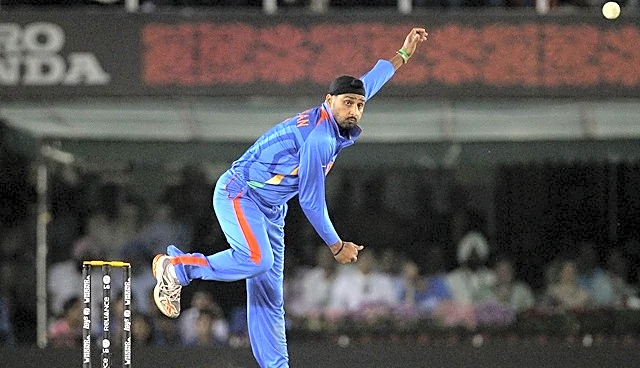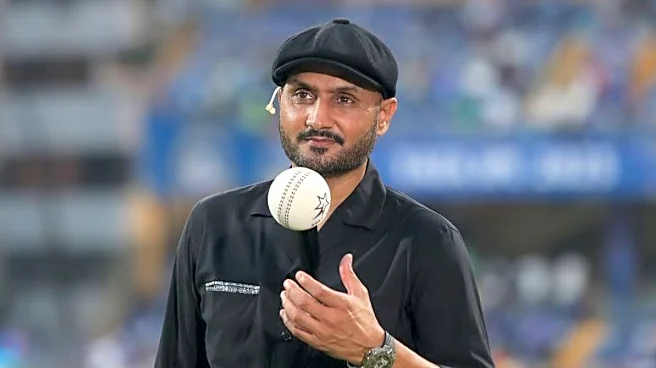


Harbhajan Singh, the India off-spinner who made his debut in 1998, has expressed concern about how modern batters approach Test cricket. Speaking in a recent podcast interview, Harbhajan highlighted a fundamental shift in the way cricketers construct their innings in the longest format. He drew comparisons between the batting mindset of his playing era and the current generation, which has grown up under the influence of Twenty20 cricket.
Harbhajan noted that in the T20 era, the approach to Test cricket
has changed significantly. The former World Cup winner pointed out that very few modern batters can score 250 or 300 in an innings, and triple centuries in Tests have become increasingly rare. He emphasised that the patience required to build large innings has diminished compared to his time as a player.
"When we started playing cricket, it was slightly slow-paced although it was consistent with the times that we were in. There were only a few batters who would deal in sixes," Harbhajan said as quoted by NDTV Sports.
Australia's aggressive Test cricket approach in the early 2000s
Harbhajan reflected on how Australia revolutionised Test cricket tactics from 2001 onwards, becoming the first team to consistently pursue rapid scoring in the longest format. Their approach forced other nations to reconsider their own strategies and adapt their bowling plans accordingly. This shift marked a turning point in how Test cricket was played at the international level.
"If I look from 2001, Aussies were the only team that would score quickly in Tests, ahead of its times. Others played normal cricket and score 250 runs in a day whereas Australia would look at scoring 350 in a single day every time, they dominate," Harbhajan said.
Harbhajan explained that bowlers had to adapt their strategies to counter the aggressive Australian approach of that period. The shift in Test cricket tactics required different planning and execution from opposing teams. He reflected on how the game has evolved since then, with the influence of shorter formats becoming increasingly pronounced.
"So you got to come with a different plan and different mindset, how to stack up those dot balls and try to make him play a different shot. But I believe the charm of Test cricket was what we played back in the day. The match would go on for five days, and on the fifth day, you won't know which team would win," Harbhajan said.
How opportunities have expanded for modern cricketers
Harbhajan also discussed how the expansion of international cricket formats has changed opportunities for aspiring players. In earlier decades, competition for places in the Indian team was far more intense, with many talented batters unable to secure a spot despite scoring heavily in domestic cricket. The introduction of multiple formats has created more pathways for players to represent their country.
"In earlier times, people slogged for even 10 years to play for India. There were a lot of players who scored huge runs like Amol Mujumdar and Amarjeet Kaypee, who couldn't play for India. Because there was no place in the senior team. But now with three formats, you have more opportunity to play for India," Harbhajan concluded.