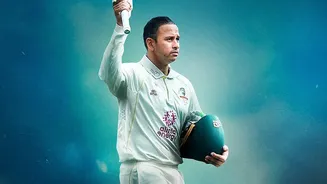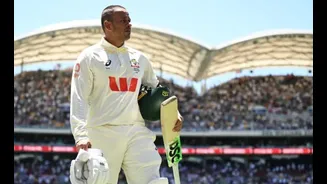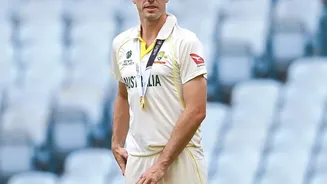

On March 24, 2018, the Australian cricket team's tour of South Africa became engulfed in controversy when ball-tampering was discovered at Newlands Cricket
Ground in Cape Town. Steve Smith and David Warner each received 12-month bans from international and domestic cricket, while Cameron Bancroft was suspended for nine months. Eight years later, Usman Khawajahas reopened the debate by insisting that accountability for the incident should have extended across the entire touring squad rather than concentrating sanctions on three individuals.
Khawaja's intervention comes through his autobiography, titled Sabr, and an interview with ABC on Tuesday, November 10. The former Australian batter has stressed that his account was never intended to conduct what he termed a witch hunt against specific players, but rather to encourage the broader playing group to acknowledge their collective role in what transpired during the South African tour.
"I mean, I've written in my account from what I've seen. I've told you again, time and time again, like the easiest way for me to do it, and people want to know the answers and lots of different answers. And I've left it open-ended to some respects because I've told my story and I've told my truth and I'll speak for myself and there's other times where I'm talking about what's happened in that situation, but this has never been a witch hunt for me," Khawaja said as quoted by NDTV Sports.
"It's only been those three guys who've had to cop this flak for a long time. I'm hoping other people will come up and talk about it honestly. That's what I'm hoping but I'm not forcing anyone to do anything," he added.
Why did Khawaja question the investigation's thoroughness?
Khawaja emphasised his concern for the three sanctioned players, who he believes have borne an unfair burden of public scrutiny and responsibility for years. He expressed sympathy for Smith, Warner and Bancroft, arguing that if the entire squad was aware of or complicit in the ball-tampering activities, the consequences should have reflected that broader involvement rather than isolating a select few.
"But I felt for those three guys that kept having to share the load for the whole time," Khawaja said.
How did Khawaja moderate his initial account?
Khawaja has criticised the Cricket Australiainquiry process itself, contending that it lacked the rigour necessary to establish a complete picture of events. Despite being positioned alongside Bancroft during the incident, Khawaja was never formally interviewed as part of the investigation. This omission, according to Khawaja, raises fundamental questions about how comprehensive the examination truly was.
"I don't feel like it was a thorough investigation because I never got investigated and I was sitting next to Cameron Bancroft the whole time. So it's hard for me to say cover-up, but I will say it felt rushed," Khawaja said.
When preparing his autobiography for publication, Khawaja deliberately tempered his original draft to avoid appearing to target specific individuals. He removed names and details during the editing process to achieve what he considered a balanced approach while remaining truthful about his observations. His primary objective was to tell his story honestly without inflaming tensions or appearing to conduct a personal vendetta against teammates.
"It's never been for me about pointing fingers and saying, ‘He did this, he said that.' And that's why even when I first wrote my edit, there was names, there was lots of things, I pulled it back. Sometimes I'm very specific on things and sometimes they're a bit vague on things and I do it on purpose because I'm trying to tell a story. But my main objective here is always to try to take accountability as a team. To say, yes, this was happening. And even though that one person did it or the captain knew about it and David Warner always took the heat too for it, that it wasn't just them, that we were all involved in it as a team, as a squad that was there in South Africa," Khawaja said.
What support has Khawaja received from the sanctioned players?
David Warner, one of the three players formally disciplined by Cricket Australia, has publicly endorsed Khawaja's position through social media. This backing from a directly sanctioned player underscores the complexity of the situation and suggests that at least some of those formally punished may share Khawaja's view that responsibility extended beyond the individuals disciplined by the governing body.
Khawaja has indicated that his book represents his definitive public statement on the matter. He noted that media coverage of his revelations has led to sensationalisation and clickbait, which he believes has distorted the nuance of his position. Following his ABC appearance, he cancelled further television and radio interviews related to his book tour, signalling his intention to step back from the public discussion while his written account stands as his primary contribution to the ongoing conversation about the 2018 scandal.
"So if I say to anyone, and I just keep going, I've talked on social media about this and I've written in my book. That's my statement. That's what it is. And I'm not going to really speak on any more of it at this moment in time," Khawaja said.