





Solar Eruption Unleashed
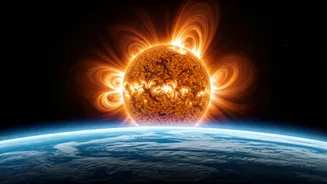
On May 10, 2026, a significant solar event occurred when the Sun released an M5.7-class solar flare. This powerful outburst originated from a specific
area on the Sun known as sunspot AR4436. The immediate consequence of this eruption was a disruption of high-frequency radio communications, particularly affecting the Atlantic region. Beyond the radio blackouts, the flare also propelled a substantial cloud of charged solar particles, known as a coronal mass ejection (CME), into space. A significant portion of this ejected plasma was observed to be heading in Earth's direction, with initial projections indicating a minor impact around May 13th. This sequence of events highlights the dynamic and sometimes disruptive nature of our Sun's activity.
Understanding Flare Classifications
Solar flares are categorized into five main classes: A, B, C, M, and X, with X representing the most intense. Each class is ten times more powerful than the one before it. The M-class flares, like the one observed on May 10, 2026, sit in the middle of this spectrum. While not as potent as X-class flares, M-class events still possess the capability to release enormous amounts of energy. The immediate impact of such flares on Earth is often the disruption of high-frequency radio communications. This phenomenon occurs within minutes of the flare's ignition because the intense X-rays emitted by the flare ionize the Earth's upper atmospheric layers. This ionization alters the conditions necessary for radio wave propagation, leading to signal degradation and temporary communication blackouts for aviators, mariners, and amateur radio enthusiasts.
Geomagnetic Storms and Auroras
When a coronal mass ejection (CME) generated by a solar flare successfully reaches Earth, it can trigger geomagnetic storms. Even a minor G1 geomagnetic storm, the least severe classification on a scale of five, can have noticeable effects. One such effect is the potential for auroras to be visible at lower latitudes than usual. For skywatchers in regions like northern England, Scotland, and parts of the northern United States, including cities like Seattle and Minneapolis, this means the chance to witness the spectacular Northern Lights. These celestial displays are a direct result of charged particles from the Sun interacting with Earth's atmosphere and magnetic field, a spectacle amplified during periods of heightened solar activity. This particular event occurs as the Sun is nearing the peak of its 11-year solar cycle, a phase known as solar maximum.
Approaching Solar Maximum
The current period is marked by the Sun's approach to solar maximum, the zenith of its roughly 11-year activity cycle. This phase is characterized by a significant increase in the frequency and intensity of solar phenomena such as flares and CMEs. Consequently, eruptions like the M5.7 event on May 10, 2026, are anticipated to become more common and potentially more powerful as the solar cycle progresses towards its peak. This heightened activity means that space weather events that can affect Earth, including radio disruptions and geomagnetic storms, are more likely. Scientists and space weather forecasters closely monitor these developments to predict potential impacts and ensure preparedness for the energetic Sun's influence on our planet and its technological systems.