





Listening for Dark Matter
Dark matter, the invisible scaffolding of the universe, comprises over 85% of its matter content, yet it barely interacts with anything except through
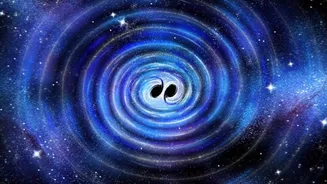
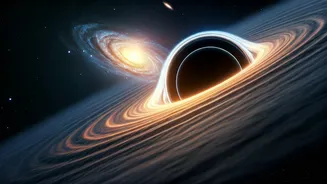
gravity. This makes it incredibly difficult to detect directly. However, scientists have devised a novel approach that harnesses the immense power of black hole collisions. The theory is that if two black holes spiral into each other while passing through a dense region of dark matter, the resulting gravitational waves – the ripples in spacetime itself – might carry subtle imprints of this invisible substance. Researchers have developed sophisticated models to predict precisely how these gravitational waves would be altered by the presence of dark matter. By comparing these predictions with actual data collected by gravitational wave observatories, they aim to find evidence of dark matter's pervasive influence on these cosmic events. This method offers a promising new avenue to probe one of physics' most enduring enigmas, turning cataclysmic cosmic mergers into sensitive detectors for the universe's hidden components.
The Elusive Nature
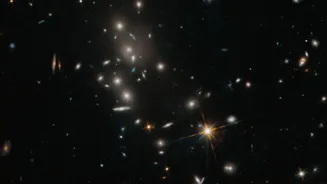
The mystery of dark matter continues to baffle scientists, largely because it doesn't interact with light or any other form of electromagnetic radiation, rendering it completely invisible. Our understanding of its existence stems solely from its gravitational effects. Astronomers first inferred its presence by observing how light bends around galaxies – a phenomenon known as gravitational lensing. The visible matter within these galaxies couldn't account for the observed distortions, leading to the conclusion that an unseen mass, dark matter, must be present. Current estimations place its abundance at more than 85% of all matter in the cosmos. One leading hypothesis suggests that dark matter might be composed of extremely lightweight particles, potentially behaving like waves when near black holes. A process called superradiance could occur, where a spinning black hole transfers rotational energy to these dark matter particles, significantly amplifying their density in the vicinity. It's this amplified density that scientists believe could leave a detectable signature on the gravitational waves generated during black hole mergers.
Decoding Gravitational Waves
To understand the potential signatures of dark matter in gravitational waves, researchers developed a sophisticated modeling technique. This method allows them to predict the specific patterns, or waveforms, that gravitational waves would exhibit if two black holes collided in an environment rich with dark matter, contrasting it with a collision occurring in a vacuum. Through detailed numerical simulations, they explored various scenarios involving colliding black hole binaries, adjusting factors like their masses, the density of the surrounding dark matter, and the degree to which the black holes spun up the dark matter. The goal was to predict what a gravitational wave carrying a dark matter imprint would look like after traveling vast cosmic distances to reach detectors on Earth. This predictive power is crucial for sifting through the immense volume of gravitational wave data collected by observatories like LIGO, Virgo, and KAGRA (LVK). The team then applied their model to publicly available data from LVK's first three observing runs, focusing on the 28 clearest signals recorded.
A Signal of Interest
Analyzing the 28 clearest gravitational wave signals from LVK's initial observations, the research team found that 27 of them closely matched the expected patterns for black hole mergers that occurred in a vacuum. However, one particular signal, designated GW190728 and detected on July 28, 2019, exhibited a notable 'preference' for the team's dark matter model. This suggests that GW190728 might indeed carry an imprint of dark matter. Scientists had previously estimated this signal to originate from a black hole binary with a combined mass of approximately 20 times that of our sun. The new analysis indicates that such a binary could have merged within a dense cloud of dark matter, producing a waveform similar to GW190728. While the researchers emphasize that the statistical significance of this finding is not high enough to definitively claim a dark matter detection, it highlights a critical point: without advanced models like theirs, such signals might be misclassified as originating from a vacuum. This opens up the exciting possibility of discovering dark matter in the vicinity of black holes as observatories continue to collect more data.