





Foundations of AI
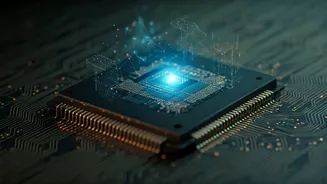
The extraordinary world of semiconductor chips, enabling billions of transistors on a minuscule surface, powers everything from data centers to smartphones
and the burgeoning field of artificial intelligence. Building these chips involves work at the nanometer scale, where even the slightest imperfection can jeopardize an entire product. The convergence of AI and semiconductors is creating exciting career paths. According to Gokul Subramaniam, president of Intel India, while AI garners significant attention, it's the silicon that truly underpins this revolution. He emphasizes that computation and semiconductors form the bedrock of AI; all AI functionalities ultimately rely on these chips. This intricate foundation is built upon a chain of interconnected engineering disciplines. It's not a singular role but a spectrum encompassing chip architecture, circuit design, verification, post-manufacturing testing, board integration, thermal management, and the overall system's performance in various applications. Significantly, AI tools are now integral to every phase of this process, from initial design to final validation. These tools initially act as assistants, accelerating the creation of early versions, and with ongoing advancements, they are poised to handle even more complex responsibilities in chip development.
Interdisciplinary Expertise
Subramaniam issues a crucial caution to students and emerging professionals: avoid mistaking the use of AI tools for a genuine understanding of engineering principles. He stresses that a robust grasp of fundamental concepts is non-negotiable and without compromise. Before leveraging AI for tasks like circuit design or system optimization, a deep comprehension of how these systems function is paramount. Semiconductors represent a nexus of diverse engineering fields. Electrical engineering dictates circuit design, while computer science informs processor architecture and software development. Mechanical and materials engineering play vital roles in chip packaging and efficient heat dissipation. Even the intricacies of manufacturing involve elements of chemistry and physics. Therefore, a confluence of many engineering disciplines is essential. To forge a career resilient to future changes, students should cultivate deep expertise in one core area while maintaining an awareness of its connections to other fields. Consider your expertise in two dimensions: your primary discipline, such as electrical engineering or computer architecture, and the specific application domain for the chip—be it data centers, edge devices, robotics, automotive systems, or defense. The unique demands of these domains profoundly influence chip design and manufacturing processes. Possessing knowledge in both dimensions provides engineers with a significant competitive advantage. Furthermore, the rapid evolution of AI, outpacing previous technological shifts like the advent of PCs or the internet, necessitates constant learning and adaptation. Engineers must embrace curiosity, actively experiment, test new approaches, and engage in continuous learning to stay relevant in this dynamic environment.
The Power of Tinkering
Subramaniam consistently advocates for a hands-on approach through 'tinkering.' When evaluating new graduates, his focus extends beyond academic transcripts to assess fundamental knowledge coupled with genuine curiosity. He seeks evidence of practical engagement, such as personal projects, experimentation, and lessons learned from both successes and failures. Tangible proof, like a GitHub repository, a prototype circuit built in a lab, or a simulation project that underwent iterative improvements, signals a candidate's proactive involvement. However, he identifies a gap in the hiring process for fresh graduates: a disconnect between theoretical knowledge and practical application. He warns that an overemphasis on examinations at the expense of projects can expose underlying weaknesses. The solution lies in actively seeking hands-on experience through internships, summer breaks, and utilizing open-source tools. Students are encouraged not to wait for perfect institutional support but to take initiative by forming teams, finding mentors, and pursuing independent building projects. For professionals already established in the industry, Subramaniam advises reflecting on how AI can enhance their efficiency. Viewing AI as an augmentation tool, an 'exoskeleton,' that amplifies capabilities rather than replacing them is key. Simultaneously, exercising caution regarding data security and adhering to company policies when using public AI tools is essential. Ultimately, he urges young engineers to embrace enthusiasm over apprehension. Engineering has always evolved, but the current pace is unprecedented. Despite the microscopic scale of AI-driven chips, the opportunities in this field are vast. Individuals who combine a strong foundation in core principles, an understanding of diverse engineering fields, and a persistent willingness to experiment will be exceptionally well-positioned to excel at the intersection of silicon technology and artificial intelligence.