
Frame-Dragging Confirmed
Scientists have celebrated a major breakthrough in astrophysics: the confirmation of frame-dragging, a crucial concept in Albert Einstein's theory of general
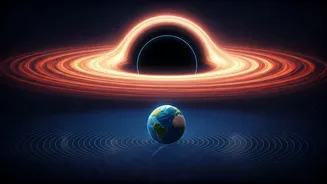
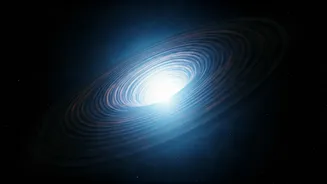
relativity. The study's main focus was on observing the orbital motion of a star that was orbiting a supermassive black hole. The measurements that were collected demonstrated that the black hole's gravity was indeed causing the space around it to warp and twist. This phenomenon, which is known as frame-dragging, was proposed by Einstein over a century ago. The recent findings strongly validate Einstein's theory, providing solid empirical evidence for a core prediction. This observation has not only confirmed a theoretical concept but has also refined our understanding of how gravity operates in extreme conditions near massive objects, offering scientists a richer perspective on the universe's most formidable structures.
The Wobbling Orbit
The method of observing the star's wobbling orbit involved tracking its path over a period of time. By monitoring the subtle shifts in the star's movement, researchers could observe the effects of frame-dragging. These subtle changes, or "wobbles," were a direct result of the supermassive black hole's immense gravitational field. As the black hole spun, it dragged the surrounding spacetime with it, causing the star's orbit to deviate slightly from what would be expected under Newtonian physics. The highly precise measurements taken in the study accurately matched the predictions made by Einstein's theory, offering further validation. The study underscored the precision of the observational techniques and the accuracy of the theoretical framework.
Implications for Science
The discovery holds significant importance for astrophysics, reinforcing the groundwork of general relativity and providing insights into the extreme environments close to supermassive black holes. The study not only validates the theoretical basis of frame-dragging but also offers potential prospects for more precise measurements of black hole properties, such as spin and mass. Scientists can now utilize these observations to improve their models of galactic dynamics and better understand the formation and evolution of galaxies, as supermassive black holes lie at the centers of most galaxies. This research sets the stage for future exploration, creating a pathway for scientists to refine their grasp of gravity and space-time.