







AI Token Mandate
Nvidia's chief executive, Jensen Huang, has conveyed a clear directive to the company's engineering workforce: embracing and extensively utilizing AI tools
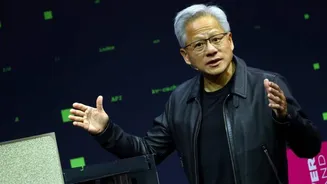
is paramount for productivity. This stance underscores the deep integration of token-based computing within Nvidia's operational framework. Huang articulated during the All-In Podcast at Nvidia GTC 2026 that the company is prepared to make substantial investments in AI tokens to bolster its engineering teams' capabilities. He expressed concern that highly compensated engineers not consuming a significant volume of these tokens might not be performing optimally. To illustrate, Huang proposed a thought experiment where a $500,000-a-year engineer spending only $5,000 on tokens would raise serious alarms. He asserted that if such an engineer didn't utilize at least $250,000 worth of tokens, he would be profoundly worried about their productivity and efficiency in leveraging advanced computational resources for their tasks.
Industrial Revolution Parallel
Huang drew a compelling parallel between the adoption of modern AI tools and the transformative machinery introduced during the Industrial Revolution. Just as that era's innovations allowed workers to manage tasks previously deemed too arduous, large, or time-consuming, AI is now poised to revolutionize mental labor. This analogy suggests that AI can function as powerful 'machinery' for cognitive work, liberating engineers from routine operations and enabling them to concentrate on more creative and strategic aspects of their roles. This represents a fundamental shift in how software is developed, moving from traditional coding to defining ideas, architectures, and specifications. Huang envisions a future where each engineer is empowered by a multitude of AI agents working alongside them, amplifying their creative output and problem-solving capabilities.
Industry-Wide Adoption
The trend of integrating AI computing power into employee compensation packages is not unique to Nvidia; several other technology firms are beginning to adopt this strategy. The underlying principle is that equipping employees with ample AI tokens can dramatically boost their productivity and efficiency. This approach is gaining traction as companies recognize the potential of AI to augment human capabilities. However, the widespread integration of AI in corporate settings is not without its challenges and concerns. Reports indicate that a significant portion of CEOs have yet to witness clear, demonstrable benefits from their AI adoption efforts, with a small percentage reporting improvements in revenue or cost reductions. Furthermore, instances of AI-related disruptions have surfaced, including notable issues at Amazon Web Services stemming from 'Gen-AI assisted changes' that had a wide-ranging impact.