






A Cosmic Revival Begins
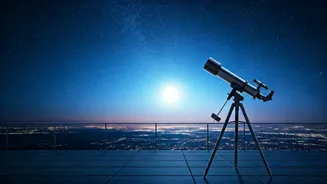
On warm Visakhapatnam evenings, a unique gathering unfolds along Beach Road. Amidst the coastal breeze, a telescope becomes the focal point for curious
onlookers, each taking a turn to peer into the celestial expanse. These are the celebrated moon watch sessions, orchestrated by the Vizag Astronomy Club, a local initiative that has steadily cultivated an appreciation for the night sky within the city. What began as an informal endeavor by BSS Srinivas, driven by a simple desire to share the profound joy of astronomy, has blossomed into structured public events. From its inception with just one telescope and a handful of neighbours and friends, the club's dedication has seen it evolve, offering captivating glimpses of the moon and fostering a quiet yet persistent astronomical culture. These sessions are more than just observations; they are moments of shared wonder, drawing both newcomers and seasoned sky-gazers into the silent spectacle above.
Echoes of Early Astronomy
The Vizag Astronomy Club's current efforts resonate with a historical legacy in astronomy within the region. It's noteworthy that as far back as 1840, Gode Venkata Jaggarow established a private observatory on his estate in what is now Dabagardens, representing one of the earliest documented engagements with astronomical study in the area. While this historical fact might not be widely known today, the club's activities are effectively serving to reawaken an interest in this scientific pursuit. The moon watch sessions, affectionately known locally as Chandra Darshanam, are intentionally designed to be open and accessible to everyone. These events are typically scheduled from the fourth day after the new moon through to the full moon phase. During this period, lunar features become increasingly discernible, offering clearer views through both the naked eye and telescopic observation. Currently, these sessions take place along Beach Road between 6:30 PM and 10:00 PM and are planned to continue until April 3, welcoming visitors without any need for prior registration, a welcoming approach that has significantly boosted attendance.
First Encounters With Wonder
For many individuals experiencing the night sky through a telescope for the very first time, the encounter is often profoundly moving. Srinivas observes that their reactions frequently mirror the awe experienced by early astronomers. He elaborates, 'They realize the moon is not smooth, but full of craters, ridges and plains.' He recounts an instance where a child, after looking through the eyepiece, expressed a newfound understanding of why ancient civilizations developed rich mythologies and stories centered around the moon. Srinivas emphasizes that 'Such responses indicate how direct observation can reshape perception more effectively than mediated images.' Beyond the sheer visual spectacle, these sessions incorporate guided explanations. Knowledgeable volunteers discuss the formation of lunar craters, present evidence of past volcanic activity on the moon, and explain its crucial role in stabilizing Earth's environment. Furthermore, the sessions delve into how early civilizations named lunar features and devised calendars based on its phases, ensuring that 'the emphasis remains on linking observation with understanding, rather than presenting astronomy as distant or abstract,' according to Srinivas.
Intimate Sky Gazing
In more recent times, the Vizag Astronomy Club has expanded its offerings by introducing private, terrace-based viewing sessions across various locations in the city. These more intimate gatherings, typically lasting two to three hours, are specially organized for families and smaller groups seeking a more personalized experience. Srinivas notes that 'Many participants prefer the familiarity of their own spaces, where conversation flows more easily and the experience feels less formal.' He has personally led over 60 such sessions, often coinciding with significant celestial events such as planetary alignments or prominent lunar phases. The club's inventory of equipment is diverse, catering to a range of observational needs. This includes Dobsonian, equatorial, Galilean, and Newtonian telescopes, which facilitate both basic introductory observations and more detailed astronomical study. For those yearning for a deeper level of engagement, the club hosts monthly star parties and astronomy camps. These events offer extended, often overnight, sessions where participants can interact directly with seasoned observers and dedicate more time to exploring the intricacies of the night sky.
Growing Stellar Community
The increasing interest in astronomy is clearly reflected in the club's membership growth. Alongside approximately 100 long-standing members, the Vizag Astronomy Club now boasts around 300 active participants, a testament to its expanding reach. Srinivas attributes this significant expansion to a discernible shift in public curiosity. He observes that many individuals, accustomed to digital displays, initially anticipate telescopic views to resemble high-resolution digital images. 'They come with that idea,' he remarks. However, once they experience celestial objects directly through a telescope, the profound reality of the observation imbues the experience with a distinct and elevated significance. The Beach Road sessions, held in front of Ambica Sea Green Hotel, run from 6:30 PM to 10:00 PM and will continue until April 3. The subsequent Moon Watch program is scheduled to commence on April 21. For further inquiries or details, interested individuals can reach out via phone at 6304963367.