



A New Era Dawns
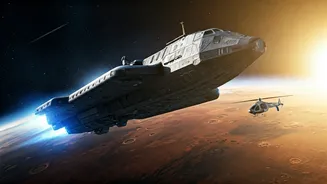
NASA is embarking on a revolutionary mission, codenamed Skyfall, aiming to deploy nuclear-powered helicopters to Mars by the year 2028. This ambitious
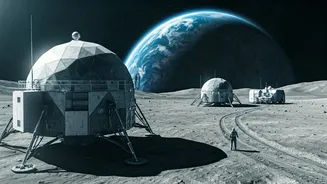
undertaking signifies a monumental leap in space exploration, moving beyond incremental improvements to fundamentally alter our capabilities for venturing into the cosmos. The successful execution of this mission could establish nuclear power as the standard for future space expeditions, enabling quicker and more productive journeys. Ultimately, this technology is a crucial step towards making interplanetary travel more accessible, bringing the dream of human settlements on other celestial bodies closer to reality. The Skyfall mission isn't just about a single experiment; it's about opening a new chapter for humanity's presence in space, potentially shrinking the vast distances that currently separate us from planets like Mars.
Nuclear Power's Edge
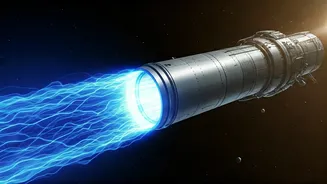
The core innovation driving the Skyfall mission lies in nuclear thermal propulsion, a technology NASA indicates is two to five times more efficient than conventional chemical propulsion systems. This enhanced efficiency translates to the ability to travel at greater speeds or carry significantly larger payloads without the prohibitive need for massive fuel reserves. Crucially, nuclear propulsion is independent of solar radiation, making it an ideal solution for deep space missions where sunlight is scarce and traditional methods falter. Traditional chemical rockets rely on rapid fuel combustion, whereas nuclear propulsion offers a consistent, highly effective power source. Two primary technologies are under development: nuclear thermal propulsion, which heats a propellant like hydrogen using a reactor to create thrust, and electric propulsion, which utilizes nuclear-generated electricity to power ion engines.
Overcoming Mars Hurdles
One of the most significant obstacles to human missions to Mars is the extended travel time, which currently spans anywhere from six to nine months. The adoption of nuclear propulsion holds the potential to drastically shorten this journey, thereby mitigating both health risks for astronauts and the substantial financial expenditures associated with prolonged space travel. NASA, in collaboration with DARPA, has already initiated space-based testing of nuclear rocket engines. This crucial phase aims to validate the technology's readiness before its integration into the Mars mission. As NASA's Deputy Administrator Pam Melroy stated, this demonstration is a vital step towards enabling human expeditions to the Red Planet. Beyond enhancing travel speed, nuclear technology also offers the inherent advantage of power generation, a capability that is indispensable for long-duration missions and robust planetary exploration.
Technological Breakthrough
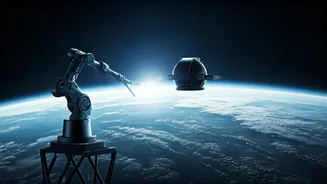
The Skyfall mission represents a significant technological breakthrough by integrating propulsion, power generation, and advanced exploration capabilities into a single, cohesive endeavor. Unlike prior missions heavily reliant on solar power and batteries, nuclear power provides a consistent and uninterrupted energy source, irrespective of environmental conditions or distance from the sun. This continuous power supply is essential for long-duration missions, allowing for more in-depth scientific investigations and the exploration of Mars's challenging terrains without the limitations imposed by intermittent energy sources. The mission's design, potentially incorporating concepts like the Space Reactor-1 (SR-1), aims to showcase the efficacy of nuclear power in space. Furthermore, the spacecraft may be equipped to deploy robotic assets, such as helicopter drones, enhancing the scope of Martian exploration by accessing remote and difficult-to-reach locations.