





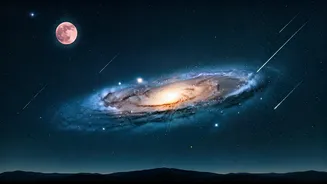

The Pink Moon's Origin
The full moon gracing our skies on April 1, 2026, carries the evocative name 'Pink Moon.' This moniker doesn't signify a change in the moon's actual color
but rather draws from historical and cultural traditions, particularly those of the Algonquin tribes in North America. They used this name to mark the blooming of moss pink (Phlox subulata), an early spring flower that carpets the ground in vibrant hues. This naming convention connects the lunar cycle to the natural world's transformations, specifically the arrival of spring in the Northern Hemisphere. For scientists, this celestial event presents an opportunity to study lunar mechanics, observing phenomena like the moon's orbital position relative to Earth and the Sun.
Why It Appears Brighter
During a full moon, our planet, Earth, is positioned directly between the Sun and the Moon. This alignment, known as syzygy, allows sunlight to fully illuminate the side of the Moon facing us. In 2026, this full moon's proximity to the vernal equinox plays a role, subtly influencing the Moon's tilt and how sunlight reflects off its surface. A phenomenon called 'opposition surge' will also contribute to its unusual brightness. This occurs because, from our vantage point on Earth, the angle of observation minimizes the appearance of shadows cast by lunar craters, making the Moon seem more luminous than at other times.
The 'Pink' Illusion
While the name 'Pink Moon' is poetic, the Moon itself will not transform into a rosy hue. However, a scientific effect can cause the Moon to appear pinkish when it is low on the horizon. As moonlight travels through a greater thickness of Earth's atmosphere near the horizon, shorter blue wavelengths of light are scattered away by atmospheric particles. This scattering leaves the longer, reddish and pinkish wavelengths to reach our eyes, giving the Moon a subtle, temporary blush. This atmospheric scattering is a natural optical phenomenon, not a change in the Moon's composition.
Tides and Lunar Influence
The 2026 Pink Moon occurs near perigee, the point in the Moon's orbit where it is closest to Earth. This proximity, combined with the full moon phase, means there will be a greater gravitational pull on Earth's oceans, leading to amplified tidal ranges. This is known as a 'perigean full moon.' While this period will see increased tides, the most significant 'King Tides' are anticipated later in the month, around April 17-21, during the new moon phase. King tides are a result of the combined gravitational forces of both the Moon and the Sun aligning with Earth's oceans, intensifying tidal movements.
Observing Lunar Details
While the Danjon scale is typically used to assess lunar features during eclipses, it's not the primary tool for observing the 2026 Pink Moon due to varying atmospheric conditions. Instead, astronomers will focus on 'seeing,' which refers to atmospheric stability, to determine the clarity of lunar details. A fascinating aspect of observing the full moon is the opportunity to witness lunar libration. Due to the Moon's slightly elliptical and tilted orbit, it exhibits a gentle 'nodding' and 'swaying' motion. This libration allows observers, over the course of the month, to see up to 59 percent of the lunar surface, including features on the far eastern limb that are usually obscured from view.
The Flatness Effect
The full moon often appears flatter than crescent phases, a phenomenon related to the Opposition Effect, also known as the Seeliger Effect. During the full Pink Moon, the Sun, Earth, and Moon are aligned, resulting in a phase angle of zero degrees. This direct illumination eradicates shadows cast by craters on the lunar surface. Consequently, the Moon appears brighter overall, but the absence of shadows diminishes the perception of topography. The lunar highlands, devoid of their usual shadowed contours, look uniformly bright, contributing to the impression of a flatter surface.
Peak Illumination Time
The astronomical definition of a full moon occurs at the precise moment of maximum illumination. For the 2026 Pink Moon, this peak will be reached at 02:12 UTC on April 2. However, for viewers in the United States, this translates to Wednesday evening, April 1, at 10:12 PM Eastern time. It's important to note that the Moon will appear fully illuminated for approximately a full day before and after this exact moment, making it appear full to the casual observer for an extended period around the peak time.