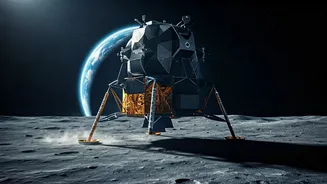







Historic Lunar Return
Prepare for a momentous occasion as Netflix hosts a live broadcast of NASA's Artemis II mission, marking humanity's first journey back to the Moon in over
half a century. This historic flyby offers a rare opportunity for space enthusiasts worldwide to witness this significant achievement virtually. The excitement surrounding this mission is palpable, echoing the immense public interest seen during the launch. Following the incredible viewership of the launch, which drew millions online and hundreds of thousands to the Kennedy Space Centre, the streaming giant's involvement promises to bring this celestial event to an even wider audience. Originally, there were plans for Netflix to stream the departure, but these shifted, leading to their current role in broadcasting the lunar flyby itself, ensuring that this pivotal moment in space exploration is accessible to everyone.
The Tech Behind the Stream
The remarkable feat of livestreaming from space, where conventional internet is non-existent, is made possible by NASA's innovative Orion Artemis II Optical Communications System, or O2O. This advanced laser communication technology utilizes infrared light, invisible to the human eye, to transmit data instead of relying on traditional radio waves. This cutting-edge system significantly enhances data transmission capabilities, allowing for the streaming of high-definition 4K video and high-resolution images at impressive speeds of up to 260 megabits per second. NASA receives this vital information through laser signals at ground stations located in either Las Cruces, New Mexico, or Table Mountain, California, with the selection dependent on prevailing cloud conditions to ensure a clear signal pathway.
Navigating Space Communication
During the Artemis II mission, astronauts are expected to experience a temporary communication blackout. This brief period of silence will occur when the spacecraft passes behind the Moon, severing the direct line of sight with mission control in Houston, Texas. This event, anticipated around 4:17 AM IST on Tuesday, April 7, highlights the inherent challenges of deep-space communication. For astronauts undertaking such extensive missions, maintaining constant contact with mission control is not merely a technical requirement; it serves as an essential lifeline, providing support and connection to Earth during their incredible journey beyond our planet's immediate reach.
Mission Crew and Journey
The Artemis II mission is helmed by a distinguished crew of four astronauts: Commander Reid Wiseman and Pilot Victor Glover from NASA, alongside Mission Specialist Christina Koch from NASA and Mission Specialist Jeremy Hansen from the Canadian Space Agency. Their journey toward the Moon commenced on April 1, 2026, aboard the powerful Space Launch System (SLS) rocket, which lifted off from the Kennedy Space Centre. After successfully completing a critical engine firing nearly 42 hours post-launch, the crew broke free from Earth's orbit on April 3, 2026, embarking on their ambitious 10-day voyage around the lunar surface. This mission represents a significant step in NASA's long-term objectives for lunar exploration and beyond.
An Unexpected Glitch
Despite the overall success of the 10-day journey towards the Moon, the Artemis II crew encountered a minor technical hiccup during their mission. Shortly after their departure from Earth, astronauts experienced an issue with the Microsoft Outlook application on their personal computing devices (PCDs) aboard the spacecraft. Commander Reid Wiseman reported two separate instances where the email platform failed to function correctly, prompting a request for remote technical assistance from the mission control center in Houston. While this was a small setback, it underscores the complex technological environment astronauts operate within during space missions.