





Sungrazer's Solar Encounter
The celestial body known as Comet MAPS (C/2023 A3 Tsuchinshan–ATLAS) embarked on a highly anticipated journey, with expectations of becoming a brilliant
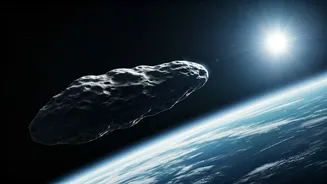
spectacle visible even during daylight hours. This type of comet, a 'sungrazer,' is characterized by its trajectory that brings it extremely close to the sun. These comets are believed to be fragments from a much larger, ancient comet that shattered long ago. Initially estimated to be about 1.5 miles (2.4 kilometers) in diameter, further observations by the James Webb Space Telescope revealed its true size to be much smaller, approximately 0.25 miles (0.4 km) across. Despite its reduced size, the potential for a dazzling display, akin to the celebrated Comet Lovejoy in 2011, kept astronomers and skywatchers enthralled, with some even speculating it might outshine its predecessors.
A Fiery Death Dive
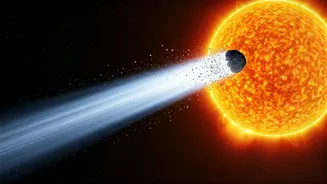
Comet MAPS reached its perihelion, the point of closest approach to the sun, on Saturday, April 4th. During this perilous dive, it ventured into the sun's outer atmosphere, the corona, at an astonishingly close distance of merely 100,000 miles (160,000 km) from the solar surface. This is less than half the average distance between the Earth and the Moon. While this intimate solar encounter was hidden from ground-based telescopes due to the sun's overwhelming brightness, several space-based observatories, including the Solar and Heliospheric Observatory (SOHO), were in position to capture the event. The mission was to observe its passage and subsequent display, but the intense conditions proved too much for the comet's fragile structure.
Headless Wonder Emerges
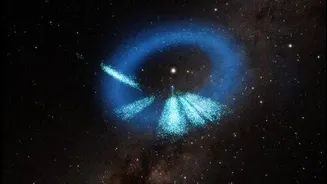
The close encounter with the sun marked the unfortunate end for Comet MAPS. Instead of emerging as a brilliant spectacle, the comet disintegrated under the immense thermal stress and gravitational forces. Traveling at an incredible speed of about 1 million mph (1.6 million km/h), its icy nucleus was likely vaporized and torn apart. SOHO's time-lapse imagery captured the dramatic moment: the comet entered the solar disk, but only a diffuse cloud of dust and gas spewed out from the other side. This phenomenon led to it being described as a 'headless wonder' – a comet seemingly devoid of a solid nucleus, leaving only a ghostly trail of its former self. This debris, known as striae, briefly shimmered before quickly scattering, leaving no visible trace of Comet MAPS.
Comets in the Shadow
While Comet MAPS met a dramatic end, the astronomical community's attention has shifted to other celestial visitors. The demise of MAPS has amplified the anticipation for Comet C/2025 R3 (PanSTARRS), which is also slated to reach its perihelion in April. However, PanSTARRS presents a more favorable scenario for observation. It will pass considerably farther from the sun, at approximately 46.4 million miles (74.6 million km), significantly reducing the risk of disintegration. This safer trajectory makes it a more reliable target for amateur astronomers equipped with telescopes or binoculars. The period just before its solar approach, particularly around the new moon, is predicted to offer the darkest skies, maximizing viewing potential. Experts have even posited that PanSTARRS could be the 'Great Comet of 2026,' a prediction now gaining more credence following the fate of Comet MAPS.