





From Sci-Fi to Reality
The concept of a rocket gracefully returning to Earth for reuse once seemed like pure science fiction, a notion confined to futuristic tales. However,
over the past decade, this audacious idea has been materialized by SpaceX. Initially met with skepticism, the ability to land a massive booster upright after its fiery journey to space is now a regular occurrence. Following their initial successful touchdown in December 2015, the company encountered its share of challenges with booster recovery attempts. Yet, through persistent innovation and meticulous engineering, SpaceX has refined this complex process to a remarkable degree of reliability and precision, making the seemingly impossible, routine.
A View from Above
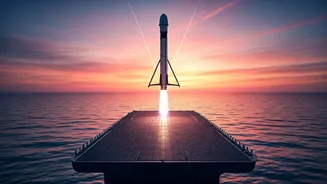
Recently, SpaceX shared compelling footage showcasing one of its latest Falcon 9 booster landings. This captivating video, captured by a camera affixed to the rocket itself, provides a dramatic, up-close perspective of the booster's journey back to terrestrial shores. The mission originated from the Vandenberg Space Force Base in California, tasked with deploying 25 Starlink satellites into low-Earth orbit. The booster supporting this particular flight, designated B1093, was making its 11th appearance, having previously launched other Starlink constellations and specialized payloads like SDA T1TL-B and SDA T1TL-C. As the video vividly illustrates, after the successful deployment of its upper stage, the approximately 41.2-meter-tall booster embarked on its descent, ultimately touching down on the 'Of Course I Still Love You' droneship positioned in the vast expanse of the Pacific Ocean.
The Descent Sequence
Achieving an autonomous landing of a Falcon 9 booster is a multi-stage, precisely orchestrated ballet of engineering. Following the separation from the upper stage, the booster initiates a controlled flip maneuver utilizing its cold gas thrusters. This is often complemented by a boostback burn to refine its trajectory. As the booster plummets through the atmosphere, its aerodynamic grid fins deploy, providing crucial steering to navigate the atmospheric currents. A critical entry burn then decelerates its descent, preparing it for the final phase. The climax of this sequence is the landing burn, executed just moments before touchdown, coupled with the deployment of its robust landing legs, ensuring a stable and secure arrival on the designated landing platform.
Pioneering Reusability
The paramount advantage of these successful rocket landings lies in their direct contribution to booster reusability. By enabling the recovery and refurbishment of these sophisticated components, SpaceX significantly reduces the overall cost associated with space missions. This economic benefit, in turn, democratizes access to space, opening up opportunities for a wider array of companies and research organizations to pursue their orbital ambitions. This commitment to reusability is not just theoretical; it's continually setting new benchmarks. For instance, another Falcon 9 booster recently established a new record for reuse, completing its 33rd flight after its inaugural launch in June 2021, a testament to the durability and successful implementation of this groundbreaking technology. The invaluable lessons learned from these Falcon 9 landing procedures are now being meticulously applied to the development of their much larger and more powerful Starship rocket, which is slated for its 12th test flight in March.