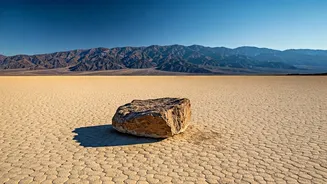









A Geological Puzzle
The phenomenon of Death Valley's sliding rocks, a geological puzzle, has long intrigued both scientists and enthusiasts. Located within the arid expanse
of Death Valley National Park, these rocks, varying in size and weight, leave visible trails across the flat, dried lakebed known as Racetrack Playa. These trails are a testament to their mysterious movements. For years, the cause of this peculiar behavior remained uncertain, spawning various theories ranging from hidden magnetic forces to extraterrestrial involvement. However, none provided a satisfactory explanation for the rock's erratic journeys across the playa's surface. The enigmatic nature of the sliding rocks made them an irresistible subject for scientific investigation, driving researchers to explore the dynamics of this natural phenomenon.
The Ice Factor
The breakthrough in understanding the sliding rocks came from identifying the pivotal role of ice. Researchers found that a thin layer of ice forms on the playa's surface during the colder months, a crucial element in the rock's movement. This ice, created after rainfall, forms into thin, floating ice sheets as the temperature drops. These sheets, often no thicker than a few millimeters, encapsulate the rocks and provide the means for their movement. As the ice melts, the rocks can move more easily. This unique interaction between the rocks and the ice, along with the subsequent thawing, allows for their slow, deliberate journeys across the playa.
The Wind's Influence
While ice provides the mechanism, the wind serves as the driving force. The playa's landscape is exposed to considerable wind patterns, which exert pressure on the ice sheets. These sheets, carrying embedded rocks, are propelled across the playa's surface by the wind. The precise alignment of these two elements, ice and wind, creates the circumstances under which the rocks can be pushed, often at speeds of just a few inches per second. The force of the wind, acting on these ice rafts, leads to the formation of the distinctive trails that trace the rocks' paths across the landscape. The combination of ice and wind is an extraordinary example of nature's delicate interplay.
Decades of Research
Solving the mystery of the sliding rocks was a feat that required years of dedicated research and rigorous investigation. Scientists employed several methods to uncover the driving forces behind the movement. They monitored the rocks with GPS tracking, installed weather stations, and documented the conditions on the playa. The GPS data revealed the rocks' paths, while the weather stations provided valuable details on the wind speed, temperature, and ice formation. The continuous monitoring, along with the collection of environmental data, aided in constructing a clear picture of the interaction between ice, wind, and rocks. Each piece of information, gathered meticulously, brought the scientists closer to understanding this captivating geological puzzle.
Trail Formation Explained
The trails left behind by the sliding rocks are direct evidence of their movement. The trails are formed as the rocks, encased in ice, slide along the playa's surface, leaving a groove in the soft sediment. The depth and width of the trails can vary, depending on the rock's size, weight, and the thickness of the ice sheet. These paths, often straight but sometimes curved, provide a detailed record of the rocks' journeys across the playa. Some trails demonstrate the rocks changing direction, while others exhibit the rocks' paths as they travel for long distances, sometimes for many meters. These tracks serve as a visual testament to the power of the natural elements at work in Death Valley.
Rare Conditions Combined
The sliding rocks are a result of a convergence of rare environmental conditions. The correct interplay of freezing temperatures, a thin layer of water, and sufficient wind is not often present. The ideal scenario usually happens during the winter season. The thin ice formation, the appropriate wind speeds, and the exposed, flat surface of the playa are all indispensable. This rare alignment of circumstances creates the necessary environment for the rocks to move. This means that the sliding rocks will not occur at all times or in any place. The convergence of these elements makes Death Valley's sliding rocks such a distinctive and intriguing phenomenon.
A Scientific Triumph
The discovery of the mechanism behind the sliding rocks represents a triumph for scientific inquiry. The solution, arrived at by relentless research, exemplifies how patient observation and advanced technology can explain nature's complex phenomena. By understanding the combined forces of ice and wind, scientists have brought a final end to a long-standing mystery. The findings enrich our understanding of Earth's dynamics and emphasize the significance of meticulous field research. The scientific triumph also highlights the beauty and complexity of the natural world, further inspiring future studies.