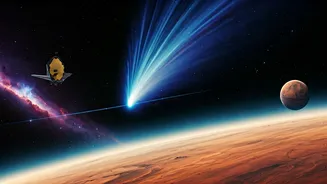








Comet ATLAS' Arrival
Interstellar Comet 3I/ATLAS is poised to make a close approach to Earth on December 19, offering a remarkable chance for scientists to study a visitor
from beyond our solar system. This comet, unlike those originating within our neighborhood, provides a glimpse into the composition and characteristics of celestial bodies formed elsewhere in the galaxy. The encounter presents an invaluable opportunity to gather data about the origins and evolution of comets, potentially revealing insights into the early solar system's formation and the interstellar environment's nature. This will likely involve detailed observations using telescopes and other instruments to analyze the comet's tail, coma, and nucleus, providing clues about its composition, structure, and behavior as it interacts with the solar wind. The study of 3I/ATLAS will help us enhance our understanding of how comets evolve, the distribution of materials throughout the galaxy, and the potential for these cosmic travelers to deliver water and organic compounds to planets.
Dark Matter Unveiling
The James Webb Space Telescope (JWST) has the potential to reveal more about dark matter in unexpected ways. Unlike traditional methods that rely on direct detection of dark matter particles or indirect observations through gravitational lensing, JWST's high sensitivity and advanced capabilities may facilitate the discovery of new phenomena related to dark matter. Scientists are investigating how JWST could analyze the light from distant galaxies to detect subtle distortions caused by dark matter, offering a new perspective on its distribution and influence. Moreover, the telescope may provide crucial data on the properties of the early universe, allowing researchers to study how dark matter affected the formation of galaxies and large-scale structures. The innovative use of JWST could revolutionize the way we understand dark matter, possibly leading to a more comprehensive understanding of the universe's composition and evolution. These findings could help answer questions about the fundamental nature of the universe.
Mars' Cosmic Butterfly
The European Space Agency (ESA) has revealed a city-sized ‘Cosmic Butterfly’ crater on Mars, offering intriguing clues about the Red Planet's history. The crater, bearing signs of ancient water, is a significant discovery as it suggests that Mars may have had a more hospitable environment in the past. Researchers are utilizing data from ESA missions, such as the Mars Express, to study the crater's structure and the geological features within it. These investigations aim to determine the volume and duration of water present and assess the possibility of past life. The crater's formation and the preservation of water-related minerals suggest that Mars may have had a more complex geological history. Such findings advance our understanding of how Mars evolved and the potential for past or present life. Ongoing research is expected to provide further insights into the crater's formation, the presence of water, and its implications for the planet's overall history.