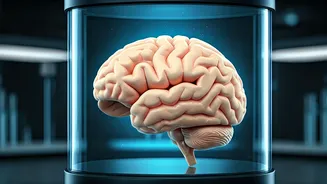







Brain's Physical Attributes
The human brain, an extraordinary organ, is primarily composed of water, fat, and protein. But have you ever considered its weight? The typical adult human brain weighs
roughly 3 pounds (approximately 1.3 to 1.4 kilograms). While the size and weight of the brain can vary slightly from person to person, this average provides a general understanding of its substantial presence within the skull. This seemingly compact organ is an intricate network of billions of neurons and supporting cells, responsible for everything from our basic bodily functions to the complexities of thought, memory, and emotion. The brain's weight reflects its intricate architecture and remarkable capacity for processing information.
Size and Intelligence
The question of whether brain size correlates directly with intelligence has intrigued scientists for years. Though larger brains often possess more neurons, the relationship isn't always straightforward. While it's true that humans have relatively large brains compared to other species, the link to intelligence is complex. Factors such as brain structure, the efficiency of neural connections, and the organization of different brain regions play critical roles in determining cognitive abilities. Furthermore, brain size isn't the sole indicator of intelligence; other elements, such as the number and interconnectedness of brain cells, are also significant. Therefore, while brain size is a factor, it doesn't entirely dictate an individual's intellectual capabilities.
Brain Cells: An Overview
The human brain is a hive of activity, thanks to billions of specialized cells. Neurons, the primary cells, transmit information via electrical and chemical signals. Estimates suggest that the human brain contains around 86 billion neurons. These neurons form an extensive communication network, enabling everything from sensory perception to complex thought processes. Besides neurons, the brain also has glial cells, which provide support and maintain the neural environment. These cells help neurons function optimally, contributing to the brain's overall efficiency. This intricate interplay of neurons and glial cells allows the brain to perform its diverse and essential functions, maintaining our existence.
Time Perception's Influence
How we perceive time is not a simple, objective measure; it's affected by various factors, including our brains. The passage of time can seem to speed up or slow down depending on our emotional state, age, and experiences. For example, as we grow older, time often appears to accelerate. This could be due to changes in brain function and the way our memories are formed. During childhood, new experiences are abundant, creating more memories, which can make time seem to stretch. As we age, however, familiar experiences are more common. The brain's processing of information influences our subjective sense of time, making it a psychological construct that is always evolving.
Brain's Post-Mortem State
What happens to the brain after death remains a complex topic. After a person dies, the brain's activity diminishes, leading to the cessation of neurological functions. However, the brain doesn't immediately decompose. For a short time following death, some cellular activity may persist. The brain's preservation depends on multiple variables, including the environment. The cellular structure starts to break down relatively soon after death. If the body is embalmed or preserved in certain conditions, this breakdown is slowed. The exact processes involved in brain decomposition, and how they occur, vary. This area remains a subject of ongoing scientific investigation, driven by a desire to comprehend the intricacies of the human body, from life to death.