






A Stellar Mystery
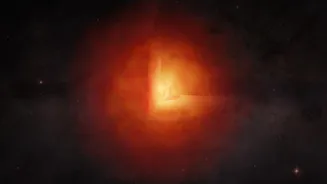
Betelgeuse, a red supergiant star located in the constellation Orion, has always been a subject of great interest. Its characteristics and behavior have
intrigued astronomers for decades. The star is known for its irregular pulsations and, at times, dramatic dimming, which has led to speculation about its eventual supernova explosion. The Hubble Space Telescope has played a crucial role in providing data to examine the mysteries surrounding this star. These efforts aimed to ascertain its true characteristics, including the possible existence of a companion star.
Hubble's Revelations
The recent discovery by the Hubble Space Telescope provides fresh insight into Betelgeuse's environment. It detects a wake, indicating the presence of a previously unknown companion star. The evidence supports the theory that Betelgeuse might have a companion that significantly influences its surroundings and behavior. The team studying the data was able to confirm the presence of a companion star and its impact on the surrounding environment. This observation is important as it offers confirmation of prior theories, suggesting that Betelgeuse is not a lone entity but an integral part of a binary system. The companion star has been identified, and its interaction with Betelgeuse is now being studied in detail.
The Wake Explained
The wake detected by Hubble is crucial in understanding the binary nature of the Betelgeuse system. It's formed by the interaction of stellar winds emitted by both stars. As the companion star moves through space, it interacts with the material being ejected by Betelgeuse, creating this observable wake. The wake is evidence of the companion's presence, as its gravitational pull and motion disturb the surrounding material. Such wake structures are frequently observed around binary systems, serving as observational evidence to track how the two stars interact and impact their immediate surroundings. These findings have profound implications for our broader comprehension of how stars evolve in binary systems, which is important for understanding the universe.
Long-Held Theory Validated
The identification of a wake offers validation for long-standing theories about Betelgeuse and its hidden companion. For years, scientists have hypothesized that Betelgeuse's unusual behavior, including the irregular dimming, could be due to interaction with a companion star. The observations from the Hubble Telescope offer concrete evidence to bolster these ideas. This finding encourages further research into the star's dynamic behavior, which can refine current astrophysical models. The discovery gives new insights into the evolutionary paths of supergiant stars and how their characteristics are influenced by binary companions. Consequently, the study emphasizes how important space-based observatories such as Hubble are for advancing our understanding of the universe.
Significance of Research
The discovery by the Hubble Space Telescope adds substantially to the knowledge of stellar evolution and the dynamics of binary systems. By observing the wake and confirming the presence of a companion, scientists can enhance their models of how stars, especially massive ones like Betelgeuse, evolve. This research has far-reaching implications, influencing our understanding of the lifecycle of stars, supernovae, and the universe's overall composition. Every new observation contributes to a more thorough understanding of these celestial bodies and expands the capabilities of astronomical observations. Future research will build upon the discovery, exploring the intricacies of binary star interactions and their impact on the surrounding galactic environment.