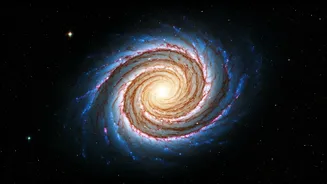

JWST's Cosmic Eye
The James Webb Space Telescope (JWST), with its advanced technology, is designed to observe the universe in infrared light, a spectrum invisible to the human
eye. This capability is pivotal because it allows the telescope to see through cosmic dust clouds that often obscure visible light, enabling observation of distant galaxies and celestial objects. The JWST is equipped with a large mirror and sophisticated instruments, making it sensitive enough to detect the faint light from the earliest stars and galaxies. By studying the light from these distant objects, scientists hope to gain insights into the formation and evolution of the universe. The JWST's capacity to gather detailed data from space is significantly enhancing our ability to observe and analyze various celestial phenomena, including those that may offer crucial information on dark matter.
Seeking Dark Matter
Dark matter, an unseen substance making up a large portion of the universe, does not interact with light, making it difficult to detect. JWST offers a new approach. The telescope's observations could potentially help map the distribution of dark matter by analyzing the way it affects the light from distant galaxies. As light travels through space, it can be bent and distorted by the gravity of massive objects, including dark matter. The JWST's instruments are finely tuned to measure these subtle distortions, thus providing clues about the distribution of dark matter throughout the cosmos. This could unlock insights into the structure and evolution of the universe. Scientists hope that with better mapping, they will be able to identify the location of dark matter and understand the role it plays in the universe.
Unlocking Dark Secrets
JWST can potentially detect traces of dark matter by studying the cosmic microwave background (CMB). The CMB is a faint afterglow of the Big Bang, and the JWST's instruments can analyze slight temperature variations across it. These variations are related to the distribution of dark matter in the early universe, allowing scientists to piece together a better understanding of how dark matter clusters and influences the formation of structures. The high-resolution observations of the CMB provided by JWST allow scientists to study these temperature fluctuations with unprecedented accuracy, possibly providing crucial details about the nature and distribution of dark matter. Through these observations, scientists may gain a clearer picture of how dark matter influenced the initial structure of the universe and its continued evolution.
Future Discoveries Ahead
The use of JWST will likely continue to evolve our understanding of dark matter. Scientists predict the telescope will help refine existing models and theories about the nature of dark matter, and could lead to new discoveries about how it interacts with other matter. By combining the data from JWST with that from other observatories, scientists can create a more comprehensive picture of the universe. Future observations could also lead to new insights into the properties of dark matter, such as its mass, and how it interacts with itself. It is expected that the JWST will make significant contributions to the ongoing exploration of this mysterious substance, improving our understanding of the universe.