
Europa's Intrigue
Europa, a celestial body orbiting Jupiter, has long fascinated scientists due to its potential for hosting life. Its icy surface covers a vast, hidden
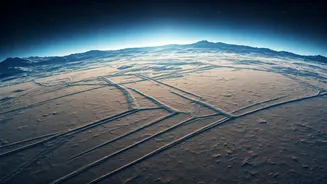
ocean. Recent research has focused on a distinctive feature resembling a spider web, found on Europa's surface. This observation has ignited discussions regarding the moon's composition and the possible existence of subsurface water. The unique network is composed of fractures and ridges and suggests a complex geologic history. The study of this unusual formation might unveil clues about the nature of Europa's internal processes and its potential for harboring life, as these spider-like structures could be related to subsurface salty water.
The Spider's Web
The so-called "spider-like" feature on Europa's surface is a network of ridges and fractures. The precise origin of this formation is currently under investigation, but it's believed to be linked to geological processes, possibly involving the movement of water or ice beneath the surface. Scientists use sophisticated imaging techniques and analysis of spectral data to study this unique formation. The spectral data helps to determine the surface's composition, looking for signs of salts or other substances that might suggest interaction with a subsurface ocean. The discovery is significant as the presence of water is essential for life as we know it, making this feature a key area of study.
Subsurface Salty Water
One of the most exciting hypotheses surrounding Europa's spider-like feature is that it could be related to a subsurface ocean of salty water. Observations from various missions, including Galileo, have provided evidence supporting the existence of this ocean, which is believed to be located beneath Europa's icy shell. The implication of salty water is very important. This type of water might be suitable for life. If confirmed, this finding would dramatically enhance Europa's potential as an environment capable of supporting life. The salty composition of the water can influence the geological activity, potentially creating favorable conditions for the emergence and development of simple life forms. Scientists are trying to understand the geological activity and how it relates to the spider-like features.
Future Missions
The exploration of Europa is a key focus for future space missions. The Europa Clipper mission, set to launch in the near future, represents a pivotal step in this direction. This mission will extensively study Europa, using a suite of advanced instruments. It will conduct flybys of the moon, gathering detailed data on its surface, composition, and internal structure. The primary goals of the Europa Clipper include determining the depth and salinity of Europa's ocean, as well as searching for potential signs of life. The data gathered by this mission will assist in deciphering the mysteries surrounding the spider-like structure and determining if the location has subsurface salty water. The information that will be collected by Europa Clipper is expected to reshape our knowledge of Europa.
Implications of Discovery
If confirmed, the connection between the spider-like feature and subsurface salty water would have profound implications for our understanding of Europa and the broader search for life. It suggests a dynamic environment with potential for geological and even biological activity. The presence of water is fundamental to life as we understand it, and the potential existence of a habitable environment makes Europa a key focus in the search for extraterrestrial life. This discovery would add credence to the idea that life can arise in various environments, even under the thick icy shells of distant moons. These findings will increase the value of future missions, such as the Europa Clipper mission, which is designed to explore Europa. Overall, the possibility of life on Europa, and in this context, makes the exploration of this moon a priority.