
JWST's Cosmic Mission
The James Webb Space Telescope (JWST), a marvel of engineering, has been instrumental in exploring the universe in ways previously unimaginable. Its advanced
instruments enable it to observe celestial objects with unprecedented clarity, far exceeding the capabilities of the Hubble Space Telescope. By examining infrared light, JWST allows us to peer through dust clouds and observe distant galaxies, stars, and planets. Through detailed observation of objects like the runaway supermassive black hole, the telescope's unique vantage point is providing valuable insights. This could revolutionize scientists' understanding of various astronomical phenomena, including the nature of dark matter.
Dark Matter's Enigma
Dark matter represents a significant puzzle in cosmology. Though unseen, its gravitational effects are evident in the rotation of galaxies and the distribution of cosmic structures. Scientists understand that it makes up a considerable portion of the universe's mass-energy content. Various hypotheses attempt to explain dark matter, ranging from weakly interacting massive particles (WIMPs) to axions and modifications of gravity. Directly observing dark matter particles is challenging because of their hypothesized weak interaction with ordinary matter. JWST's ability to observe distant, energetic events like a runaway supermassive black hole could allow indirect study, providing potential clues.
Runaway Black Hole
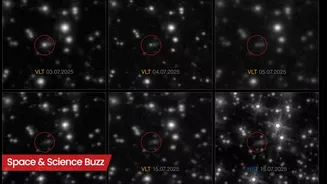
JWST’s observations have revealed a runaway supermassive black hole moving through space at approximately 2.2 million miles per hour. The black hole is moving at an unusual speed and distance from its original host galaxy. Such black holes offer a unique environment for studying their interaction with surrounding matter, and potentially dark matter. The energetic processes associated with the movement and potential interactions of the black hole provide valuable observational data. These observations provide an opportunity to probe dark matter's effects on the environment surrounding the black hole. This offers scientists a potential way to analyze this elusive substance indirectly.
Indirect Dark Matter Clues
JWST’s observations might offer an indirect means of studying dark matter. The gravitational effects of dark matter are known to influence the motions of objects, even at vast distances. By scrutinizing the behavior of matter around the runaway supermassive black hole, scientists can explore the influence of dark matter. If dark matter clumps or interacts with ordinary matter, JWST could detect subtle signatures in the black hole's wake or the surrounding environment. This indirect approach complements direct detection attempts. Although it won't directly 'see' dark matter particles, the telescope could reveal how dark matter is distributed and behaving. This will provide valuable input to current models, and also may help scientists refine their strategies for future studies.
Future Implications
JWST's continuing observations of the runaway black hole and other high-energy cosmic events hold potential for future advances. Further data collection and in-depth analysis of the data will allow scientists to refine current theories about dark matter, and may even lead to new understandings. By improving these models and finding connections between observable data and the characteristics of dark matter, scientists aim to refine strategies for direct detection experiments. The insights from JWST's unique perspective have great value, providing a novel means to study the mysteries of dark matter and enhance our comprehension of the universe's structure and behavior. It also promises a more complete understanding of cosmic processes.