
Divergent Atmospheres
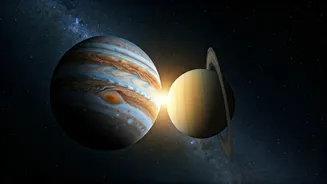
Jupiter and Saturn, both giants of gas, display marked differences in their polar weather systems. Jupiter is recognized for having a complex atmosphere
with dynamic cloud formations, including the Great Red Spot, a colossal storm. Its poles showcase vibrant auroral displays, which are powered by interactions between the planet's magnetic field and solar wind particles. Saturn, on the other hand, presents a comparatively more serene atmosphere. While it also has storms, they generally are less pronounced than Jupiter's. Saturn's poles are notable for their hexagonal jet stream at the north pole, and less visible aurora compared to its Jovian counterpart. The variances in their atmospheres could be due to differences in composition, internal heat distribution, and atmospheric dynamics, setting the stage for advanced scientific investigation.
Analytical Techniques
Scientists have employed a combination of observational methods and advanced computer simulations to study the polar weather of Jupiter and Saturn. Observational data is gathered from telescopes on Earth and space-based missions like the James Webb Space Telescope and the Cassini spacecraft. These instruments are vital for collecting data on cloud structures, atmospheric composition, and temperature profiles. The data collected by these instruments is used to validate computer models, enabling scientists to test hypotheses about the dynamics that drive weather patterns. Numerical models simulate atmospheric processes, accounting for factors such as radiative transfer, convection, and the interaction of charged particles. These detailed models allow researchers to recreate the observed polar weather and gain a clearer understanding of the forces at play in the atmospheres of Jupiter and Saturn.
Factors at Play
Multiple factors contribute to the differing polar weather patterns of Jupiter and Saturn. Jupiter's internal heat, generated from gravitational contraction, plays a vital role in fueling atmospheric activity. This heat supports robust convection and the formation of large-scale storms. The absence of a similar significant internal heat source in Saturn contributes to its more stable atmosphere. Differences in atmospheric composition are also key. Jupiter's atmosphere contains more ammonia and water, which influence cloud formation and the development of storm systems. The presence of a larger amount of methane in Saturn's atmosphere gives the planet a different coloration. The role of magnetic fields is another element; both planets have powerful magnetic fields that interact with the solar wind, producing auroras. However, variations in the strength and structure of their fields could result in dissimilar auroral characteristics and energy deposition at their poles. The study of these diverse features is integral to gaining a complete comprehension of weather patterns.
Future Directions
Ongoing research aims to further unravel the complexities of Jupiter and Saturn's polar weather through the use of advanced observational and modeling techniques. Future missions, like the Europa Clipper mission, can provide in-depth data on Jupiter's atmosphere and the interactions between its moon, Europa, and its magnetic environment. Scientists will continue to improve atmospheric models, factoring in detailed data about cloud formation, atmospheric circulation, and the effects of solar radiation. Comparative studies focusing on other gas giants in our solar system and beyond are also underway. By examining the weather patterns of exoplanets with similar atmospheric characteristics, scientists may develop a broader understanding of the fundamental processes governing planetary weather. These combined efforts promise to yield a more detailed and accurate picture of the atmospheres of Jupiter and Saturn, thus enhancing our understanding of planetary science.