






CERN's Fireball Genesis
The European Organization for Nuclear Research (CERN) has become a hub for physicists investigating the building blocks of the universe, and it is at the forefront
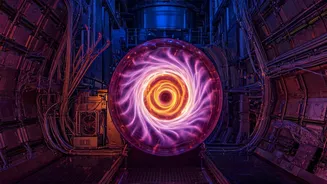
of plasma research. Scientists at CERN are currently focused on recreating conditions thought to have existed shortly after the Big Bang. Their tools include powerful particle accelerators that can generate high-energy collisions. These collisions result in what are being called 'plasma fireballs,' which are incredibly hot, dense states of matter. By studying these fireballs, scientists hope to gain insights into the nature of the early universe. The goal is to better understand a phenomenon known as the 'missing light' problem – the mystery of why we observe less light in the universe than theoretical models predict should be present. The work being done offers the possibility of a new understanding of the initial universe’s development.
Simulating Cosmic Conditions
The essence of CERN's research lies in its capacity to simulate extreme environments. The Large Hadron Collider (LHC), the world's largest and most powerful particle accelerator at CERN, is a key component. The LHC enables the scientists to collide particles at nearly the speed of light. Such collisions generate temperatures and energy densities akin to those present just after the Big Bang. The plasma fireballs formed during these collisions are short-lived. However, they provide a valuable window into the behavior of matter under extreme conditions. Researchers carefully observe and analyze these fireballs, studying their properties, including temperature, density, and the types of particles they contain. These observations are then compared to theoretical models of the early universe to look for potential explanations for missing light. The experiments are creating the conditions necessary to study the fundamental particles and forces that shaped our universe.
Unveiling Missing Light
The core mystery that CERN's plasma fireball research aims to unravel is the problem of 'missing light'. Current astrophysical models suggest the early universe should have produced more light than we currently observe. The discrepancy between what is predicted and what is seen poses a significant challenge to existing theories. One possible explanation involves the behavior of plasma in the early universe. Scientists suspect that certain interactions within plasma could have absorbed or scattered some of the light. The experiments at CERN aim to test this hypothesis by simulating the conditions in which these interactions might have occurred. By analyzing the properties of the plasma fireballs, researchers hope to determine whether the missing light can be explained by specific interactions of fundamental particles. The successful resolution of the 'missing light' problem could significantly alter our understanding of the early cosmos, providing valuable data to rewrite the history of the universe.
Beyond The Lab
The research conducted at CERN has far-reaching implications that extend beyond theoretical physics. While the primary goal of the experiments is to understand the early universe, the technologies and techniques developed have practical applications in other scientific fields. For example, the particle accelerators and detectors utilized in the plasma fireball research can be used in medical imaging, materials science, and other areas of scientific inquiry. The collaborative nature of CERN, bringing together scientists from all over the world, also promotes cross-disciplinary knowledge sharing. Furthermore, any new understanding of the early universe can have a significant effect on cosmology and astrophysics, shaping future research directions and potentially leading to new technologies. The discoveries made at CERN often influence future scientific endeavors across multiple fields, contributing to a global scientific ecosystem that advances the understanding of the world.