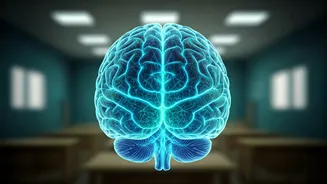








Brain's Amazing Plasticity
Children's brains are incredibly adaptable, a characteristic known as neuroplasticity. This adaptability allows them to form new neural connections quickly
and efficiently, particularly during early childhood. The brain is like a muscle that strengthens with use, with synaptic connections forming at an accelerated rate in children. This heightened plasticity means that young learners can effortlessly absorb and process new linguistic information. Adults, on the other hand, have brains with a reduced degree of plasticity, making it harder to establish new language pathways. The brain's ability to rewire itself in response to new experiences is a critical advantage for children, simplifying the complex process of language acquisition.
Immersion's Powerful Impact
Children often grow up in environments where they are constantly exposed to languages. This immersion is a powerful tool. They hear the language spoken by their parents, siblings, and friends, which is a key element. This constant exposure allows them to pick up the nuances of pronunciation, grammar, and vocabulary naturally. Adults learning a new language typically study in a classroom setting, which often lacks the immersive, everyday context. The constant use of the language in the daily lives of children accelerates their learning process. This regular interaction is far more effective than sporadic study sessions for acquiring fluency.
Uninhibited Learning Style
Children are often less self-conscious than adults when learning. They aren't afraid to make mistakes or sound silly, and this freedom enables them to experiment with language without fear of judgment. This lack of inhibition is a tremendous asset, making them more willing to practice and speak, even when they're uncertain. Adults, on the other hand, often hesitate to speak for fear of errors, which can significantly hinder their progress. This reduced self-consciousness enables children to embrace errors as learning opportunities. It fosters a more experimental approach to language use, facilitating a faster rate of acquisition.
Cognitive Advantages Emerge
Young children are at the stage of cognitive development, characterized by a unique aptitude for language acquisition. At this stage, their brains have evolved and are ready to assimilate linguistic structures. Their minds are wired to learn language, and they haven't yet developed the cognitive biases that can complicate language learning in adults. Children also have a remarkable capacity for pattern recognition, helping them understand and internalize grammatical rules without consciously studying them. This cognitive advantage, combined with their ability to quickly adapt to new information, makes language learning more seamless and effective.
Motivation's Natural Drive
Children possess a natural motivation to communicate and connect with others, driving their language learning. The need to understand and be understood by parents, caregivers, and peers serves as a constant incentive to learn. They are motivated by the desire to play, to socialize, and to express their needs and desires. This strong intrinsic motivation fuels their dedication to learning a new language. Adults, by comparison, may have external motivations for learning a language, such as career advancement or travel, which might be less powerful. This intrinsic motivation, coupled with the joy of discovery, makes language learning more enjoyable and effective for children.