







The Unseen Contrail Problem
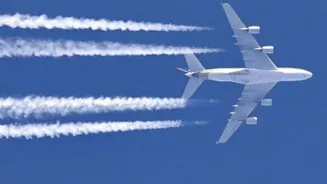
The conversation around aviation's environmental damage often centers on carbon dioxide emissions. However, a less obvious, yet equally impactful, issue
arises from the thin white streaks left in the sky by aircraft: contrails. These formations, essentially artificial clouds, have been identified as significant contributors to global warming by trapping heat within the Earth's atmosphere. While seemingly innocuous, their cumulative effect on the climate is substantial, necessitating innovative solutions to mitigate their formation and impact without drastically altering the fundamental operations of air travel.
AI's Flight Path Solution
Artificial intelligence is emerging as a powerful tool to tackle the contrail challenge. By training sophisticated AI models on vast datasets encompassing satellite imagery, intricate weather patterns, and historical flight trajectories, researchers can accurately forecast where and when contrails are likely to form. This predictive capability empowers airlines to make minor, strategic adjustments to their flight plans, such as altering altitude or slightly rerouting. These modifications are akin to pilots adjusting their course to navigate around turbulent air pockets – small changes that can effectively steer clear of conditions conducive to contrail development, thus maintaining operational efficiency while minimizing environmental harm.
Proven Results in Trials
The efficacy of AI in combating contrail formation has been demonstrated through promising real-world trials. In initial collaborations, specifically with American Airlines, the implementation of AI-guided flight routes led to a remarkable reduction in contrail creation, exceeding 50%. Expanding on this success, large-scale testing in 2025 involving 2,400 transatlantic flights yielded even more encouraging outcomes. These studies consistently showed that flights adhering to AI recommendations produced considerably fewer contrails, directly translating into a reduced associated warming impact from these atmospheric phenomena.
Why This Matters
The significance of addressing contrails extends beyond a technical curiosity; it represents a practical and positive application of AI technology. Unlike some AI applications that draw criticism for their resource intensity, this initiative offers a clear benefit to environmental sustainability. By enabling airlines to avoid contrail formation through subtle flight adjustments rather than by reducing flight volumes, a more achievable path to cleaner skies is paved. This method provides a win-win scenario, where technological advancement directly contributes to mitigating a significant environmental concern within the aviation sector.