






The Mighty Nile
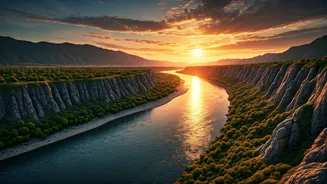
Flowing north through northeastern Africa, the Nile River, spanning an immense 6,650 km, is traditionally recognized as the world's longest. Its source
is traced to Lake Victoria, and its waters traverse a remarkable 11 countries before reaching the Mediterranean Sea. For millennia, the Nile has been the bedrock of human settlement, famously fostering the flourishing of ancient Egyptian civilization through its life-giving annual floods that enriched the surrounding lands for agriculture. Even today, this vital watercourse remains an essential lifeline for Egypt, creating a verdant ribbon of life within an otherwise arid desert landscape.
Amazon's Vast Expanse
The Amazon River, a colossal waterway of approximately 6,400 km, winds its way through Peru, Colombia, and Brazil. While often considered the second-longest, recent studies suggest its measurement might rival or even surpass the Nile, depending on the precise methodology. It is unequivocally the largest river on Earth in terms of water volume and serves as the lifeblood of the vast Amazon rainforest. This unparalleled river basin supports an astonishing 40 percent of the world's biodiversity, and during the rainy season, its waters expand dramatically, inundating significant portions of the rainforest.
Yangtze's Crucial Flow
Asia's longest river, the Yangtze, stretches for 6,300 km entirely within China. Its journey commences in the glacial meltwaters of the Tibetan Plateau and culminates in its discharge into the East China Sea near Shanghai. The Yangtze River has played an instrumental role throughout China's history, deeply influencing its culture and economic trajectory. The basin is home to a third of the nation's population and is a prime agricultural region. Furthermore, it hosts the Three Gorges Dam, the world's largest hydroelectric power station, highlighting its critical importance for energy generation and flood control.
Mississippi-Missouri System
The Mississippi-Missouri River System, extending for 6,275 km, forms the longest river network in North America. The Missouri River originates in the Rocky Mountains and merges with the Mississippi, which then flows southward through the heartland of the United States, emptying into the Gulf of Mexico. For centuries, this system has been a crucial transportation corridor and remains vital for moving agricultural goods like corn and soybeans. Its drainage basin is vast, encompassing 40 percent of the continental United States, solidifying its status as a globally significant river system.
Siberia's Yenisei
The Yenisei River, with a length of 5,539 km, begins its course in Mongolia and flows into Siberia before ultimately discharging into the Arctic Ocean. It stands as one of the largest river systems that feed into the Arctic. The Yenisei is of paramount ecological and economic importance to Siberia. Its valley, characterized by extensive forests, wilderness, and rugged terrain, offers some of the most breathtaking riverine scenery globally. The presence of hydroelectric dams and its role as a key transportation route, especially in areas with limited road infrastructure, underscore its significance.
Yellow River's Legacy
Known as the Huang He, the Yellow River spans 5,464 km and is famously dubbed the "Cradle of Chinese Civilization." This river flows through northern China, renowned for the rich, yellow silt it carries from the loess plateau, which imparts its distinctive color. Historically, the Yellow River has been intrinsically linked to the fortunes of civilizations in the region, with its recurrent floods profoundly shaping the landscape and the lives of its inhabitants. Its cultural and agricultural heritage is deeply intertwined with China's past.
Ob-Irtysh Basin
The Ob-Irtysh River System, stretching 5,410 km, commands the largest drainage basin in Asia. The Irtysh River originates in the mountains of China, traverses Kazakhstan, and then joins the Ob River in western Siberia before its final journey to the Arctic Ocean. This immense network flows through vast plains and wetlands, serving as a critical artery for regional transportation, fishing, and hydroelectric power generation. Its basin is notable for containing some of the world's most extensive wetland areas.
Paraná's South American Role
The Paraná River, measuring 4,880 km, flows through Brazil, Paraguay, and Argentina, making it the second-longest river in South America. It is a vital resource for regional agriculture and energy production, notably through the Itaipu Dam, one of the world's largest hydroelectric facilities. This river is part of a sprawling basin that supports major urban centers and extensive agricultural lands across southern South America, underscoring its economic and developmental importance.
Congo's Deep Heart
The Congo River, with a length of 4,700 km, carves its path through the heart of central Africa. It ranks as the second-largest river globally by water discharge, following closely behind the Amazon. Remarkably, it is also the deepest river on Earth, with depths exceeding 200 meters. Flowing through dense rainforests and remote African territories, it provides essential transportation for millions of people. Its substantial water discharge also makes it a significant source of hydroelectric power.
Amur's Pristine Border
The Amur River, spanning 4,444 km, serves as a natural boundary between China and Russia before it empties into the Sea of Okhotsk. In contrast to many other Asian rivers, the Amur remains largely undammed, preserving large stretches of its natural state. This river system supports a rich diversity of wildlife and unique ecosystems, providing habitats for species such as the Amur tiger and Amur leopard, showcasing its ecological significance.