
A Martian Mystery
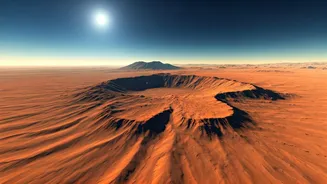
The European Space Agency (ESA) has announced the discovery of a uniquely shaped crater on Mars. This crater has a striking resemblance to a butterfly,
and it’s captured the attention of scientists worldwide. The crater’s unusual form is not only visually captivating but also provides invaluable insights into Mars's geological history. The discovery, made through detailed analysis of high-resolution images and data collected by various missions, has revealed a wealth of information about Martian processes. This crater stands as a significant finding, promising a deeper understanding of Mars's past and its potential to harbor life.
Impact and Formation
The butterfly-shaped crater is believed to be the result of a significant impact event that occurred long ago. Scientists think that an asteroid or a large space rock collided with the Martian surface, causing an explosion of immense energy. This impact carved out the initial crater. This impact was followed by complex geological processes, which shaped the crater. The impact likely caused significant upheaval in the Martian crust, leading to the formation of the distinctive butterfly shape. Studying the crater's structure helps scientists estimate the force of the impact. It also allows them to understand how such events have shaped the planet over millions of years.
Volcanic Activity Unveiled
Alongside the impact evidence, the crater reveals traces of past volcanic activity. The presence of volcanic materials and formations within and around the crater suggests that Mars was once a volcanically active planet. This volcanic activity likely played a vital role in shaping the Martian landscape. Studying the distribution and composition of these volcanic deposits is helping scientists to reconstruct the timeline of volcanic events on Mars. This is significant because it provides clues about the planet's internal heat. This also allows scientists to estimate how the planet's core has evolved over time.
Water's Potential Presence
The ESA's findings also hint at the possibility of water, either in the past or present, within the crater. The presence of certain minerals and geological features suggests that water may have interacted with the Martian surface. This presence of water is extremely significant for a couple of reasons: the first one is that the presence of water indicates that Mars may have, at some point, had a more hospitable environment. Also, water is a crucial ingredient for life as we know it. This has increased the possibility of past or present life on Mars. Further investigation is needed to determine the exact nature and extent of water-related activity within the crater.
Implications and Future
The butterfly-shaped crater discovery has significant implications for our broader understanding of Mars. It provides new insights into the planet's geological history, and the potential for past or present life. The ESA's findings will help shape future missions and research efforts aimed at exploring Mars. The ESA will continue to analyze data, gather more information, and perform follow-up investigations. It may also lead to deeper understanding of other similar craters. These further discoveries will refine our knowledge of Mars, making it possible to unravel its secrets and potentially find evidence of life beyond Earth.