





A Stellar Teenager's Bubble
Astronomers have identified an extraordinary phenomenon: a star, remarkably similar to our Sun in its nascent stages, is actively expelling a colossal
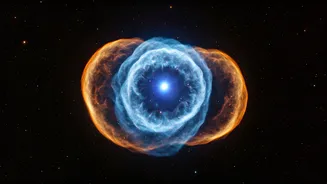
bubble of hot gas into the surrounding cosmos. This star, designated HD 61005, is located approximately 120 light-years away from our planet. While it shares basic characteristics like mass and temperature with our current Sun, its tender age of around 100 million years places it in a youthful, almost adolescent phase of stellar evolution. NASA's cutting-edge Chandra X-ray Observatory has provided an unprecedented look at the star's 'astrosphere' – essentially a vast cavity carved out by the star's powerful stellar winds, pushing against the cooler interstellar medium. This observation offers a rare and valuable window into the potential environment that our own Sun experienced billions of years ago. The spectacle isn't limited to a simple bubble; it's adorned with trailing wings of dusty debris, bestowing upon it a distinctive, moth-like silhouette. This remarkable discovery is the culmination of decades of dedicated searching and sophisticated imaging techniques. By combining Chandra's X-ray capabilities with data from infrared and optical telescopes, scientists have been able to meticulously study the star and its surrounding bubble in extraordinary detail, akin to observing a young Sun playfully interacting with its environment.
Colossal Astrosphere Revealed
The astrosphere enveloping HD 61005 is of an immense scale, stretching out to a staggering distance roughly 200 times greater than that between the Earth and the Sun. The stellar winds emanating from this young star are significantly more potent than those produced by our Sun today; they are approximately three times faster and possess 25 times greater density. These powerful outflows are responsible for inflating the giant bubble of hot gas that expands outwards into space. Scientists believe this structure might bear a striking resemblance to the heliosphere, the analogous bubble that our own Sun generates around itself, safeguarding our solar system from interstellar influences. Adding to its unique appearance are the prominent dusty wings that extend from the star, contributing to its 'moth-like' nickname. Infrared observations reveal how this cosmic dust trails behind the star as it traverses through space, appearing delicate yet demonstrating immense dynamic activity. This young star, with its expressive astrosphere, exhibits a captivating personality, offering a tangible example of energetic stellar evolution.
Decades of Astrosphere Hunt
For many years, researchers have been engaged in a persistent quest to locate and study astrospheres surrounding stars similar to our Sun, a pursuit that began as early as the 1990s. It was the advent of Chandra's high-resolution X-ray imaging technology that finally made the detailed observation of such structures feasible. The specific characteristics of HD 61005, including its relative proximity to Earth and the presence of dense interstellar matter in its vicinity—about a thousand times denser than the environment surrounding our Sun—were crucial factors enabling this discovery. The research team, spearheaded by Casey Lisse from Johns Hopkins University, meticulously analyzed the star's X-ray emissions. This detailed examination allowed them to pinpoint the precise regions where the stellar wind actively interacted with the surrounding cooler gas and dust. The resulting visualization is described as spectacular, featuring intense X-ray emissions at the core of the astrosphere, illuminated wings of infrared light stretching outwards, and the broader optical field providing context with distant stars.
Echoes of Our Sun's Youth
The study of HD 61005's astrosphere provides a valuable glimpse into the conditions that likely prevailed during our own Sun's youth. The presence of stellar winds, the trailing debris, and the overall astrosphere structure offer compelling hints about the early environment of our solar system billions of years ago. Understanding these phenomena could significantly advance our knowledge of how planets and their atmospheres initially formed and evolved. The observed activity of HD 61005 appears remarkably intense, yet it coexists with a delicate balance within its surrounding cosmic environment, presenting a captivating paradox in stellar dynamics.