






Dark Matter Cloud 9
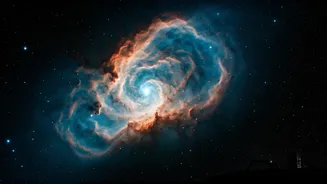
One of the most intriguing findings from the Hubble Telescope is the detection of a starless dark matter cloud. This cloud, dubbed Cloud 9, opens a window
into the dark universe, which is composed of dark matter and dark energy, the mysterious components that make up a large portion of the universe. The discovery is significant because it allows astronomers to study dark matter in a new way, potentially leading to a better understanding of its nature and distribution throughout space. The Hubble's ability to observe such a faint and distant object highlights its advanced capabilities, providing scientists with new avenues to explore the cosmos. These findings support further research into the composition and evolution of the universe.
Betelgeuse's Hidden Star
Hubble has also confirmed a long-held theory about the star Betelgeuse, revealing the wake of its hidden companion star. Betelgeuse, a red supergiant, has fascinated astronomers for years, and the new discovery adds another layer to its mystery. The observations made by Hubble provided the crucial evidence to confirm the presence of this companion star, something that scientists had suspected for a while. This finding is significant for several reasons. It demonstrates the telescope's capacity to resolve objects with extreme precision, allowing for the observation of fainter celestial bodies. Moreover, this confirmation helps in better understanding stellar systems and how stars interact with each other. These observations provide insight into the complexities of the universe.
Impact of Discoveries
These discoveries, brought to light by the Hubble Telescope, are not just interesting facts; they are significant for the entire field of astrophysics. The detection of dark matter clouds and the confirmation of Betelgeuse's companion provide astronomers with crucial information to refine and test existing theories. This research helps improve models for the structure and development of the universe, and also offers exciting possibilities for future investigations. The data captured by Hubble will keep researchers occupied, inspiring them to develop new methods of investigation. As technology advances, these findings pave the way for more detailed observations, further deepening our understanding of space and our place in it.