







Distant Celestial Body
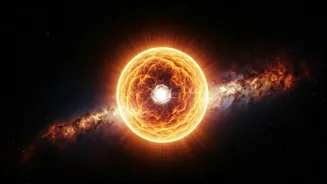
The subject of this scientific inquiry is a young star situated a considerable distance from Earth, approximately 1,950 light-years away. The sheer vastness
of space makes studying this star a significant challenge, requiring advanced astronomical tools and techniques. The location of the star is a key aspect of this research, as astronomers are directing their focus toward the Large Magellanic Cloud, a dwarf galaxy that is a satellite of the Milky Way. This region is known for its active star-forming activity, making it an ideal location to observe the early stages of stellar development. By focusing on this distant star, scientists are seeking to gather valuable data on the processes by which stars are born and evolve. The study's remote nature allows scientists to develop innovative approaches for observing and understanding distant cosmic phenomena.
Stellar Formation Study
This investigation delves into the complex processes of star formation, a fundamental area of astronomical study. The Large Magellanic Cloud serves as a cosmic laboratory, offering a rich environment where young stars are actively forming. The study concentrates on unraveling the various stages of a star's life cycle, from its initial formation within a molecular cloud to its evolution into a fully-fledged star. Key questions include how a star accretes mass, how it influences its surrounding environment, and how the interaction with other celestial bodies shapes its development. Researchers are using advanced telescopes and observational methods to collect data, including spectrographic analyses of the star's light. These detailed observations provide key insights into its physical properties, such as temperature, composition, and activity level. This detailed analysis will likely reveal new information on the processes and conditions that govern the birth and early evolution of stars.
Observational Techniques Used
The research employs a variety of cutting-edge observational techniques to study the distant star. Modern astronomical instruments provide detailed insights into the star's behavior, which in turn enable a deeper understanding of its nature. One crucial tool is spectroscopy, where astronomers analyze the light emitted by the star. This light is broken down into its component colors, revealing the star's chemical composition, temperature, and motion. Other techniques include the use of high-resolution imaging, which allows astronomers to observe the star with unprecedented detail and examine its immediate surroundings. Data from different telescopes, each observing at different wavelengths, is combined to get a comprehensive view. These different wavelengths provide distinct information about various aspects of the star. For example, some telescopes may focus on X-rays or infrared light, which allows for the detection of phenomena not visible in the light spectrum. The combined use of these technologies is essential for understanding the star.
Decoding Star Behaviour
The primary objective of the study is to decipher the unique behavior exhibited by the young star. Astronomers are keen to understand why this star acts differently from others, seeking to identify the factors that influence its characteristics. Analyzing the star's light, scientists look for variations in brightness, changes in spectral lines, and other anomalies that indicate unusual activity. Detailed observations of the star's environment will help researchers identify any interactions with surrounding gas and dust, as well as the presence of any other celestial bodies. Further analysis involves simulating the star's behavior, based on data collected, to test different hypotheses. The goal is to create models that accurately reflect the observed phenomena and provide a deeper understanding of the star’s fundamental nature. The comprehensive approach is designed to reveal the reasons behind the star's unique characteristics.
Understanding Stellar Evolution
The study's goal is to advance our knowledge of stellar evolution and understand the mechanisms by which stars evolve over time. By focusing on the young star, astronomers can observe the processes that occur early in a star's life. This could reveal new insights into the conditions and processes governing the birth, growth, and eventual fate of these celestial objects. Through detailed analysis of observational data, astronomers can develop models that simulate stellar evolution. These models not only predict how a star changes over time but also explain why specific events occur. Understanding the evolution of young stars provides a key link to understanding the evolution of the older ones. The knowledge gained from this study contributes to a larger understanding of the cosmos.